Inside the Texas Wild Hog
The Sounder and the Boar
Kinship, group composition, leadership, and communication in Texas sounders — and why a single camera detection is not a social biography.
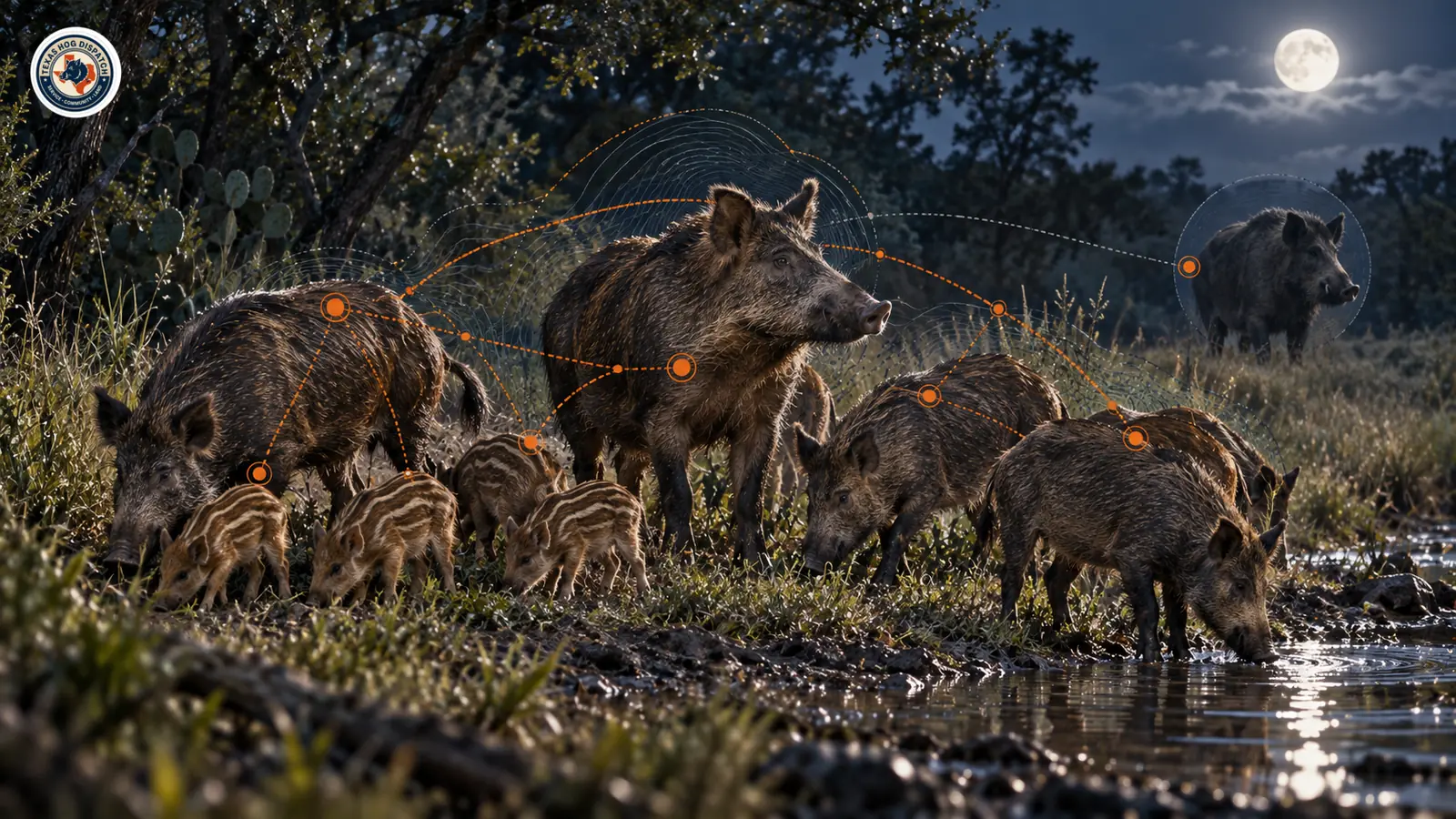
Imagine several females and young crossing a trail together, then a large male appearing alone hours later.
What the evidence shows
The contrast is recognizable, but “female family group versus permanently solitary male” is too rigid. Sounders often contain related females and young; males can associate, visit females, or change companions.
At Chaparral Wildlife Management Area, genetic and behavioral associations among monitored females broadly corresponded, and the study also detected patterns consistent with movement between groups and sounder fission. Kinship is a sound foundation for the narrative. A universal rule that the oldest sow commands every decision is not. Leadership can mean initiating travel, occupying a feeding position, or recruiting others — and those need separate measurements.
Pigs communicate through vocalizations, scent, body posture, contact, and reproductive cues. Grunts, alarm-associated sounds, squeals, and displays belong in an ethogram, not a word-for-word animal dictionary. Dominance may influence access to food and mates without every group fitting a fixed linear hierarchy. Boar fighting and shields fit a reproductive competition story, but not the assertion that one male monopolizes every litter.
Research behind this chapter: 2 sources. View research notes ↓
Texas consequence
For Texas interpretation, group membership is a moving target. Fission and movement between groups mean that a sounder photographed this month is not guaranteed to be the same set of animals next month, which matters for anyone counting individuals from camera images.
Evidence boundary
The kinship finding rests on 18 females in three Texas sounders, examined at abstract level, so not every member is necessarily related (C32). A camera's solitary detection is not a lifetime social biography (C35).
A male appearing alone on one camera is not proof that he spends his entire life alone.
Evidence boundary: Males can associate with others, visit females, or change companions. The universal “always solitary” framing is rated Unsupported/Overbroad (C35).
- Scientific ReviewS01 · evidence class SYNTHESIS · Worldwide, with substantial U.S. material
- Texas Field StudyS08 · evidence class TX-FIELD · Chaparral Wildlife Management Area; 18 females in three sounders
The popular claim: “The oldest sow always leads, and every boar is solitary.”
The defensible correction: Useful tendencies are not universal rules. Leadership has several distinct meanings that require separate measurement, and each vocalization has no fixed translation (C35).
Research notes and sources
This material documents how the chapter was checked.
Evidence used in this chapter (2)
- Scientific ReviewS01 · evidence class SYNTHESIS · Worldwide, with substantial U.S. material
- Texas Field StudyS08 · evidence class TX-FIELD · Chaparral Wildlife Management Area; 18 females in three sounders
Claim-by-claim audit (2)
- C32
Claim assessed: Female sounders often have a kinship basis.
Limit on Texas interpretation: 18 females across three Texas sounders; not every member is necessarily related.
Confidence: Supported but Conditional — Credible evidence, with meaningful context, population, design, or transfer limits.
Sources: S08
- C35
Claim assessed: The oldest sow always leads; boars are always solitary; each call has a fixed translation.
Limit on Texas interpretation: Useful tendencies do not establish universal leadership, isolation, or vocabulary.
Confidence: Unsupported/Overbroad — No defensible support located for the stated precision or universality, or the wording exceeds the evidence.
Sources: S01, S08
Original sources and studies (2)
- S01. Mayer, J. J., & Brisbin, I. L., Jr. (eds.). (2009). Wild Pigs: Biology, Damage, Control Techniques and Management. Savannah River National Laboratory, SRNL-RP-2009-00869.Open the original source: https://sti.srs.gov/fulltext/SRNL-RP-2009-00869.pdf
- S08. Gabor, T. M., Hellgren, E. C., Van Den Bussche, R. A., & Silvy, N. J. (1999). Demography, sociospatial behaviour and genetics of feral pigs (Sus scrofa) in a semi-arid environment. Journal of Zoology, 247(3), 311–322.Open the original source: https://doi.org/10.1111/j.1469-7998.1999.tb00994.x