Inside the Texas Wild Hog
Eating the Landscape
Omnivory, rooting, digestion, and the limits of stomach-content evidence in Texas wild pigs, including the South Texas carcass-investigation result.
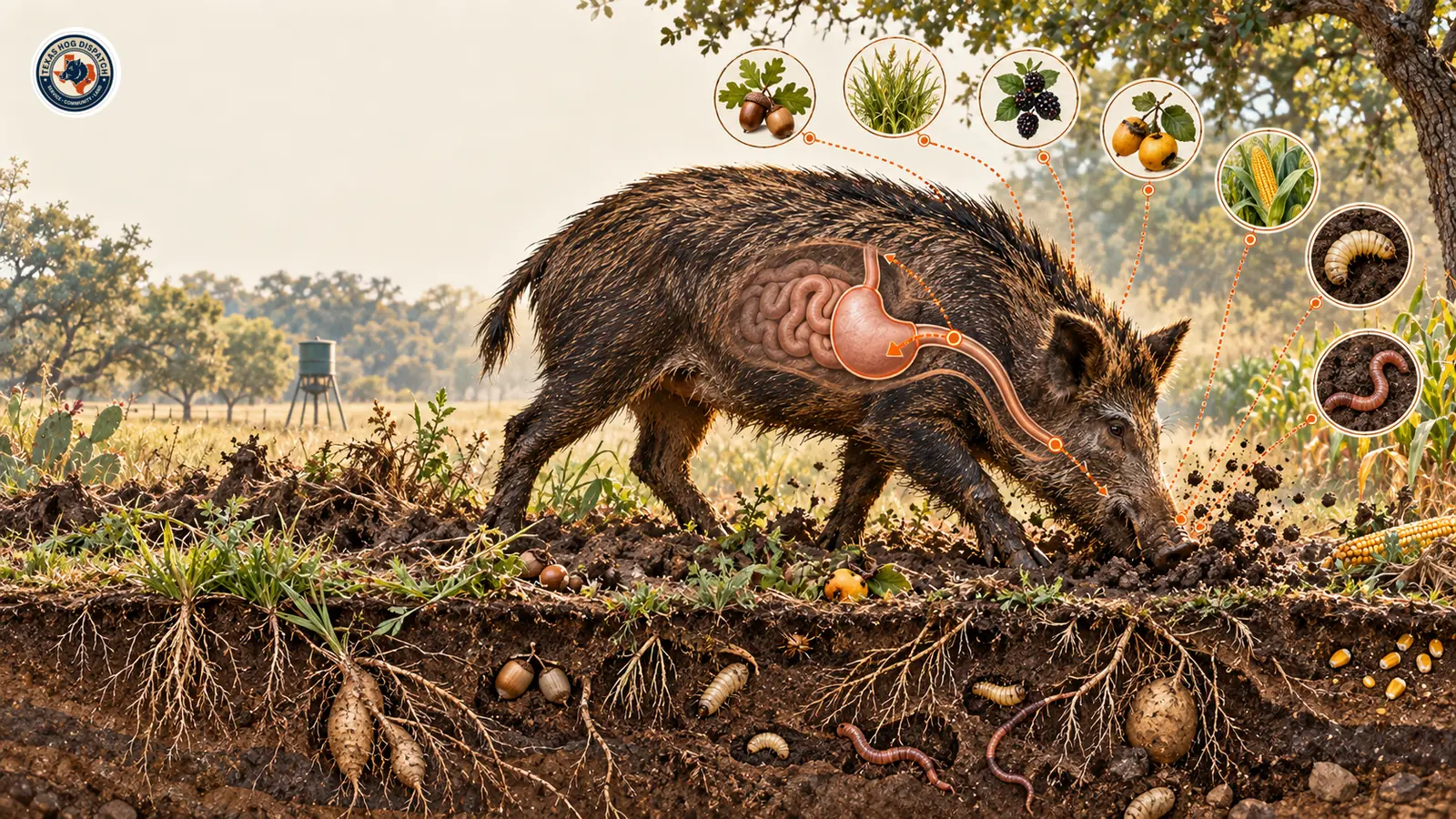
Imagine a patch of turf turned inside out. Some food was above ground, some beneath it, and some may have moved away before the snout arrived.
What the evidence shows
Wild pigs graze, browse, gather mast and fruit, root for underground resources, consume invertebrates, take animal prey, scavenge, and use crops or supplementary feed. The stomach is a snapshot of what was swallowed, not an unbiased measurement of preference, nutritional benefit, or ecological damage.
A simple stomach and small-intestinal digestion suit varied, digestible foods, while hindgut microbes contribute to fiber processing. The animal can eat vegetation without possessing a cow's foregut fermentation system. It is equally misleading to call the pig exclusively carnivorous or to say its digestive system cannot use fiber.
Seasonal access to mast, green growth, roots, invertebrates, fruit, grain, and carrion changes the menu. The direction of seasonal change in one landscape need not hold in another with irrigation or year-round feeders.
A recent South Texas carcass study supplies an instructive boundary: cameras recorded conspecific investigation without observed cannibalism. That documents behavior in the sampled conditions; it does not negate cannibalism reported elsewhere. Contact with a carcass can create a disease pathway without consumption, but that study did not measure pathogen transfer.
Research behind this chapter: 3 sources. View research notes ↓
Texas consequence
The South Texas stomach study is a valuable regional anchor, but its numerical plant fraction should not become a statewide annual constant. Crop consumption may involve standing plants, fallen grain, seed, or feeding stations, and crop damage can exceed the amount eaten through trampling and rooting.
Evidence boundary
Stomach volume differs from preference, energy, and statewide diet (C29). An animal remnant in a stomach does not distinguish active predation from scavenging; camera evidence of an actual predation event answers a different question (C30). Human sweetness does not predict hog food preference (C24).
At 59 South Texas sites, cameras recorded hogs investigating conspecific carcasses without observed cannibalism in those sampled conditions.
Evidence boundary: This does not mean cannibalism never occurs elsewhere, and the study measured no pathogen transfer. Context: 91 carcasses in a hot, semiarid setting (C48).
- Texas Field StudyS30 · evidence class TX-FIELD · San Antonio Viejo Ranch, South Texas; 59 sites / 91 carcasses
The popular claim: “Animal remains in a stomach always prove active predation.”
The defensible correction: Gut contents may not distinguish predation from scavenging. That distinction requires observation of the event itself (C30).
Research notes and sources
This material documents how the chapter was checked.
Evidence used in this chapter (3)
- Scientific ReviewS01 · evidence class SYNTHESIS · Worldwide, with substantial U.S. material
- Texas Field StudyS07 · evidence class TX-FIELD · Western South Texas; 197 stomachs reported
- Texas Field StudyS30 · evidence class TX-FIELD · San Antonio Viejo Ranch, South Texas; 59 sites / 91 carcasses
Claim-by-claim audit (5)
- C14
Claim assessed: Pigs are monogastric omnivores with hindgut fermentation.
Limit on Texas interpretation: Neither ruminants nor incapable of using fiber.
Confidence: Verified — Directly established for the stated structure, sample, or study result. Does not imply statewide universality.
Sources: S01
- C24
Claim assessed: Human sweetness predicts hog food preference.
Limit on Texas interpretation: Only some tested compounds were effective; field intake has other drivers.
Confidence: Unsupported/Overbroad — No defensible support located for the stated precision or universality, or the wording exceeds the evidence.
Sources: S18
- C29
Claim assessed: Plant foods often dominate; diet changes with opportunities.
Limit on Texas interpretation: Stomach volume differs from preference, energy, and statewide diet.
Confidence: Supported but Conditional — Credible evidence, with meaningful context, population, design, or transfer limits.
Sources: S07, S01
- C30
Claim assessed: Pigs root, prey, scavenge, and use crops.
Limit on Texas interpretation: Animal remains alone do not establish predation; damage exceeds consumption.
Confidence: Supported but Conditional — Credible evidence, with meaningful context, population, design, or transfer limits.
Sources: S01, S30
- C48
Claim assessed: South Texas pigs investigated conspecific carcasses without observed cannibalism.
Limit on Texas interpretation: It does not establish “never eat their own,” and no infection transmission was measured.
Confidence: Verified — Directly established for the stated structure, sample, or study result. Does not imply statewide universality.
Sources: S30
Original sources and studies (3)
- S01. Mayer, J. J., & Brisbin, I. L., Jr. (eds.). (2009). Wild Pigs: Biology, Damage, Control Techniques and Management. Savannah River National Laboratory, SRNL-RP-2009-00869.Open the original source: https://sti.srs.gov/fulltext/SRNL-RP-2009-00869.pdf
- S07. Taylor, R. B., & Hellgren, E. C. (1997). Diet of feral hogs in the western South Texas Plains. Southwestern Naturalist, 42(1), 33–39.Open the original source: https://www.jstor.org/stable/30054058
- S30. Leivers, S., Campbell, T., Bodenchuk, M., & Tomeček, J. (2023). Behavior of Wild Pigs toward Conspecific Carcasses: Implications for Disease Transmission in a Hot, Semiarid Climate. Transboundary and Emerging Diseases, 2023, 4195199.Open the original source: https://pmc.ncbi.nlm.nih.gov/articles/PMC12017100/