Inside the Texas Wild Hog
Learning Without an Intelligence League Table
What controlled work shows about pig learning, memory, novelty, and fear — and why a declining trap catch is not proof that every survivor learned.
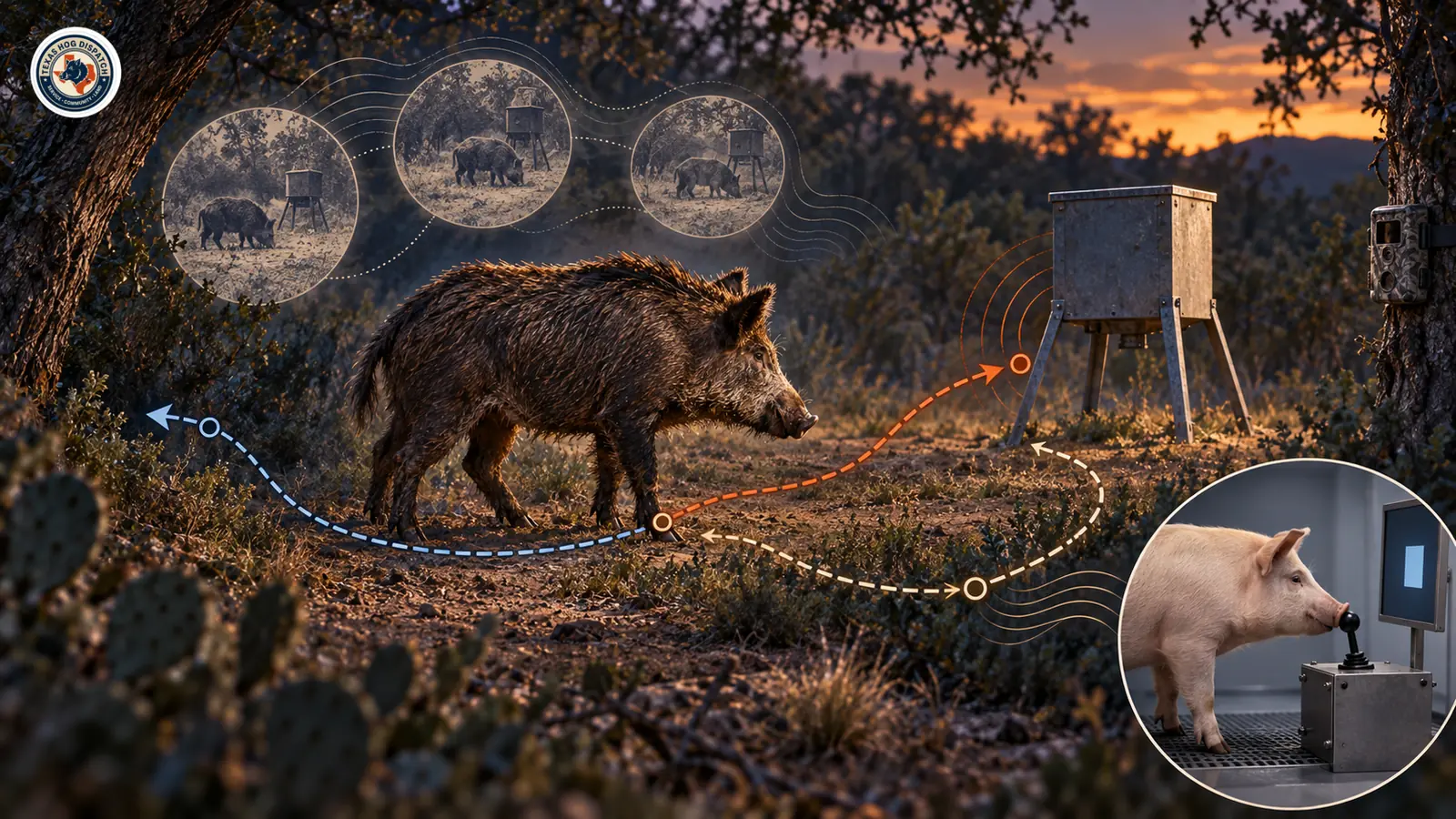
Imagine the hog returning to a familiar feeding place and finding a new metal structure. A pause, a detour, an approach, or a retreat could reflect several things at once.
What the evidence shows
The structure, a scent, another pig, a prior frightening encounter, alternative food, or an observer the camera missed could each produce that behavior. Calling every refusal “trap intelligence” hides the alternatives that a useful experiment would need to distinguish.
Domestic pigs learn spatial and operant tasks; the literature includes memory, reversal learning, discrimination, and social influences on foraging. Task performance depends on sensory access, motivation, training, stress, age, and apparatus. Four domestic pigs learned aspects of a joystick-controlled screen task — a striking but small demonstration of behavioral flexibility. It does not support “smarter than dogs,” “fourth smartest animal,” or “equivalent to a three-year-old child.”
Curiosity and caution are compatible. Habituation to a harmless repeated stimulus is not the same as learning that a location predicts danger; social facilitation is not necessarily imitation; following an experienced sow does not prove understanding of what she knows. Memory duration must be measured for a particular task rather than promoted into “a hog never forgets.” Fear is defensibly discussed through avoidance, escape, vigilance, and physiological measures. Revenge and deliberate humiliation of hunters have no evidentiary place here.
Research behind this chapter: 6 sources. View research notes ↓
Texas consequence
Patient camera observation can reveal which animals attend and enter a site, while premature capture can leave animals unremoved. Yet absence after a capture can also reflect fewer animals remaining. A declining catch is not by itself proof that every survivor learned to avoid all traps.
Evidence boundary
The joystick result describes four trained domestic pigs under specified conditions (C25). The permanence claim — that every pig remembers a trap forever — is unmeasured (C28). Alternative food, access, male presence, and local depletion all confound the inference from a missed capture (C42).
Four trained domestic pigs learned aspects of operating a screen cursor with a joystick.
Evidence boundary: No child-age comparison and no species intelligence ranking follows: different species and tasks lack a validated shared scale (C25, C26).
- Laboratory ResearchS20 · evidence class DOM-LAB
The popular claim: “Pigs rank fourth in intelligence” or “a pig equals a child of a fixed age.”
The defensible correction: No validated shared scale supports that ranking. The recovered evidence measures specific tasks under specific training conditions (C26).
Research notes and sources
This material documents how the chapter was checked.
Evidence used in this chapter (6)
- Laboratory ResearchS10 · evidence class DOM-LAB
- Scientific ReviewS19 · evidence class SYNTHESIS
- Laboratory ResearchS20 · evidence class DOM-LAB
- Texas Field StudyS28 · evidence class TX-FIELD · East and Southeast Texas; 30 replicates per treatment; 86 sera
- North American FieldS33 · evidence class NA-FIELD · South Carolina
- Texas Field StudyS08 · evidence class TX-FIELD · Chaparral Wildlife Management Area; 18 females in three sounders
Claim-by-claim audit (5)
- C25
Claim assessed: Pigs learn spatial and operant tasks.
Limit on Texas interpretation: Learning was demonstrated under specified training, not in every wild situation.
Confidence: Verified — Directly established for the stated structure, sample, or study result. Does not imply statewide universality.
Sources: S19, S20
- C26
Claim assessed: Pigs rank fourth in intelligence or equal a child of a fixed age.
Limit on Texas interpretation: No validated common ranking was recovered; different species and tasks lack the required shared scale.
Confidence: Unsupported/Overbroad — No defensible support located for the stated precision or universality, or the wording exceeds the evidence.
Sources: S19, S20
- C27
Claim assessed: Social learning plausibly affects wild foraging.
Limit on Texas interpretation: Following, local enhancement, and imitation must be distinguished.
Confidence: Strong Inference — Consistent biological reasoning supported by adjacent evidence; not directly tested for the exact Texas claim.
Sources: S19, S08
- C28
Claim assessed: Fear, novelty, and memory affect responses; every pig remembers traps forever.
Limit on Texas interpretation: The first proposition is supported conditionally; “forever” is unmeasured.
Confidence: Unsupported/Overbroad — No defensible support located for the stated precision or universality, or the wording exceeds the evidence.
Sources: S10, S19, S28
- C42
Claim assessed: Failure to enter a trap proves learning or exceptional intelligence.
Limit on Texas interpretation: Alternative food, access, male presence, and local depletion confound interpretation.
Confidence: Unsupported/Overbroad — No defensible support located for the stated precision or universality, or the wording exceeds the evidence.
Sources: S28, S33
Original sources and studies (6)
- S10. Rørvang, M. V., et al. (2023). Odor exploration behavior of domestic pig (Sus scrofa) as indicator of enriching properties of odors. Frontiers in Behavioral Neuroscience, 17, 1173298.Open the original source: https://www.frontiersin.org/journals/behavioral-neuroscience/articles/10.3389/fnbeh.2023.1173298/full
- S19. Gieling, E. T., Nordquist, R. E., & van der Staay, F. J. (2011). Assessing learning and memory in pigs. Animal Cognition, 14(2), 151–173.Open the original source: https://pmc.ncbi.nlm.nih.gov/articles/PMC3040303/
- S20. Croney, C. C., & Boysen, S. T. (2021). Acquisition of a Joystick-Operated Video Task by Pigs (Sus scrofa). Frontiers in Psychology, 12, 631755.Open the original source: https://pmc.ncbi.nlm.nih.gov/articles/PMC7928376/
- S28. Sumrall, S. A. (2011). Abatement Strategies and Disease Assessment for Feral Hogs in East Texas. PhD dissertation, Texas A&M University.Open the original source: https://oaktrust.library.tamu.edu/server/api/core/bitstreams/caa8ebc4-be90-4e98-aa46-abb8722129e7/content
- S33. Brewer, S. M., Snow, N. P., & Beasley, J. C. (2026). Proximity to bait and social interactions influence individual wild pig (Sus scrofa) visitation at bait sites. Journal of Wildlife Management, 90(5), e70220.Open the original source: https://wildlife.onlinelibrary.wiley.com/doi/10.1002/jwmg.70220
- S08. Gabor, T. M., Hellgren, E. C., Van Den Bussche, R. A., & Silvy, N. J. (1999). Demography, sociospatial behaviour and genetics of feral pigs (Sus scrofa) in a semi-arid environment. Journal of Zoology, 247(3), 311–322.Open the original source: https://doi.org/10.1111/j.1469-7998.1999.tb00994.x