Inside the Texas Wild Hog
Several Histories in One Animal
Taxonomy, domestication, and feralization in Texas wild pigs: what genetics can establish about ancestry, and what a photograph of a hog cannot.
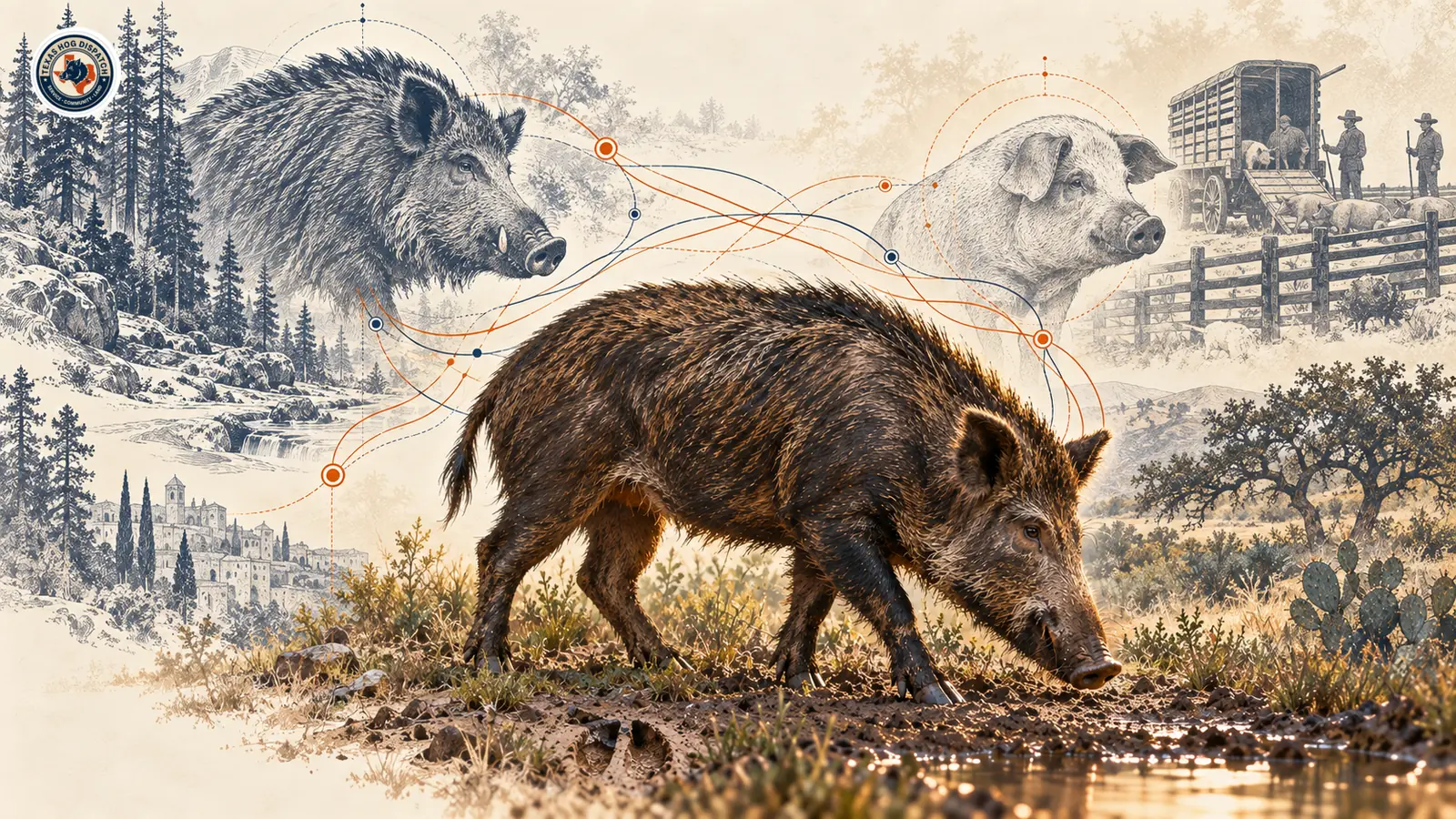
Imagine a black shape emerging from South Texas brush. Its bristles and long face seem to announce an ancient European boar. They cannot tell you its pedigree.
What the evidence shows
Coat, skull shape, ear form, age, condition, and ancestry overlap too much for a photograph to establish a genetic percentage. The animal belongs to Sus scrofa, family Suidae — the species that encompasses Eurasian wild boar and domestic pigs under widely used taxonomic treatments. Domestic forms are also called S. scrofa domesticus or S. domesticus in different conventions. “Feral” describes a history of domestication followed by free-ranging life; “wild pig” is the useful inclusive term for North American populations of feral, wild-boar, and mixed ancestry. A javelina is a peccary, family Tayassuidae, not a small wild hog.
Domestication was a prolonged process involving people moving pigs and pigs interbreeding with local wild populations. Ancient genomes show why a simple family tree can mislead: European domestic pigs acquired extensive European wild-boar ancestry after Near Eastern domestic pigs arrived. That result refines older mitochondrial reconstructions; it does not identify the ancestry of an individual Texas hog.
Texas history includes escaped or released domestic stock and introductions of Eurasian wild boar, followed by interbreeding and additional human movements. Feralization involves survival outside husbandry, selection across generations, and developmental and behavioral flexibility. It is not a proven instant genetic “switch” that makes a domestic pig revert to a pure ancestral boar.
Research behind this chapter: 5 sources. View research notes ↓
Texas consequence
South Texas genetic sampling detected structure without the simple geographic gradient expected if distance alone governed relatedness. Statewide SNP research likewise found a mixture of localized and widely dispersed genetic groupings. Human transport is a compelling explanation for part of that pattern, but genetic similarity is not an observation of a particular truck journey.
For Texas interpretation, the consequence is straightforward: moving animals can reconnect populations that separate control efforts have tried to keep apart.
Evidence boundary
Clusters are not automatically subspecies, and the clustering algorithms in the South Texas work gave different group counts. Those samples are historical, collected 2005–2009. Eurasian ancient-DNA results describe European populations; they assign no ancestry percentage to any Texas individual.
A hog's coat, ears, or bristles cannot reveal a precise Eurasian ancestry percentage.
Evidence boundary: Phenotypic overlap, age, and condition prevent that precision. Claim C03 is rated Unsupported/Overbroad.
- Scientific ReviewS01 · evidence class SYNTHESIS · Worldwide, with substantial U.S. material
The popular claim: “A feral pig instantly reverts to a pure Eurasian boar.”
The defensible correction: Feralization is not instant ancestry replacement. Development, selection, and admixture operate across generations, and the reviewed genetics does not support a genomic switch (C58).
Research notes and sources
This material documents how the chapter was checked.
Evidence used in this chapter (5)
- Scientific ReviewS01 · evidence class SYNTHESIS · Worldwide, with substantial U.S. material
- Scientific ReviewS02 · evidence class COMP-ANAT/GEN · Eurasia and comparative populations
- Scientific ReviewS03 · evidence class COMP-ANAT/GEN · Near East and Europe
- Texas Field StudyS04 · evidence class TX-FIELD/GEN · 24 South Texas sites; 1,258 adults sampled 2005–2009
- Texas Field StudyS05 · evidence class TX-FIELD/GEN · Texas statewide sampling
Claim-by-claim audit (6)
- C01
Claim assessed: Texas wild pigs belong to Sus scrofa; javelinas belong to a different family.
Limit on Texas interpretation: Domestic nomenclature varies; no new Texas taxon is implied.
Confidence: Verified — Directly established for the stated structure, sample, or study result. Does not imply statewide universality.
Sources: S01
- C02
Claim assessed: Domestic ancestry and wild-boar introgression have complex histories.
Limit on Texas interpretation: Eurasian ancient DNA does not assign a Texas individual's ancestry.
Confidence: Supported but Conditional — Credible evidence, with meaningful context, population, design, or transfer limits.
Sources: S01, S02, S03
- C03
Claim assessed: Coat, ears, or bristles alone prove a hog's Eurasian percentage.
Limit on Texas interpretation: Phenotypic overlap, age, and condition prevent that precision.
Confidence: Unsupported/Overbroad — No defensible support located for the stated precision or universality, or the wording exceeds the evidence.
Sources: S01
- C04
Claim assessed: Texas populations show genetic structure.
Limit on Texas interpretation: Clusters are method-dependent and do not equal subspecies.
Confidence: Verified — Directly established for the stated structure, sample, or study result. Does not imply statewide universality.
Sources: S04, S05
- C05
Claim assessed: Human transport contributes to nonlocal genetic patterns.
Limit on Texas interpretation: Plausible and supported, but not direct observation of each movement.
Confidence: Strong Inference — Consistent biological reasoning supported by adjacent evidence; not directly tested for the exact Texas claim.
Sources: S04, S05
- C58
Claim assessed: Feralization instantly restores a pure Eurasian genome.
Limit on Texas interpretation: Development, selection, and admixture do not imply instant ancestry replacement.
Confidence: Unsupported/Overbroad — No defensible support located for the stated precision or universality, or the wording exceeds the evidence.
Sources: S02, S03, S04, S05, S01
Original sources and studies (5)
- S01. Mayer, J. J., & Brisbin, I. L., Jr. (eds.). (2009). Wild Pigs: Biology, Damage, Control Techniques and Management. Savannah River National Laboratory, SRNL-RP-2009-00869.Open the original source: https://sti.srs.gov/fulltext/SRNL-RP-2009-00869.pdf
- S02. Larson, G., et al. (2005). Worldwide phylogeography of wild boar reveals multiple centers of pig domestication. Science, 307(5715), 1618–1621.Open the original source: https://doi.org/10.1126/science.1106927
- S03. Frantz, L. A. F., et al. (2019). Ancient pigs reveal a near-complete genomic turnover following their introduction to Europe. PNAS, 116(35), 17231–17238.Open the original source: https://pmc.ncbi.nlm.nih.gov/articles/PMC6717267/
- S04. Delgado-Acevedo, J., Zamorano, A., DeYoung, R. W., & Campbell, T. A. (2021). Genetic Population Structure of Wild Pigs in Southern Texas. Animals, 11(1), 168.Open the original source: https://pmc.ncbi.nlm.nih.gov/articles/PMC7828165/
- S05. Mangan, A. M., et al. (2021). Rooting Out Genetic Structure of Invasive Wild Pigs in Texas. Journal of Wildlife Management, 85, 1563–1573.Open the original source: https://doi.org/10.1002/jwmg.22128