Inside the Texas Wild Hog
From Bristle to Bone: The Working Body
Snout, skull, dentition, tusks, shoulder shield, and organ systems of Texas wild pigs, with the bite-force, armor, and tusk-growth overclaims separated from the anatomy.
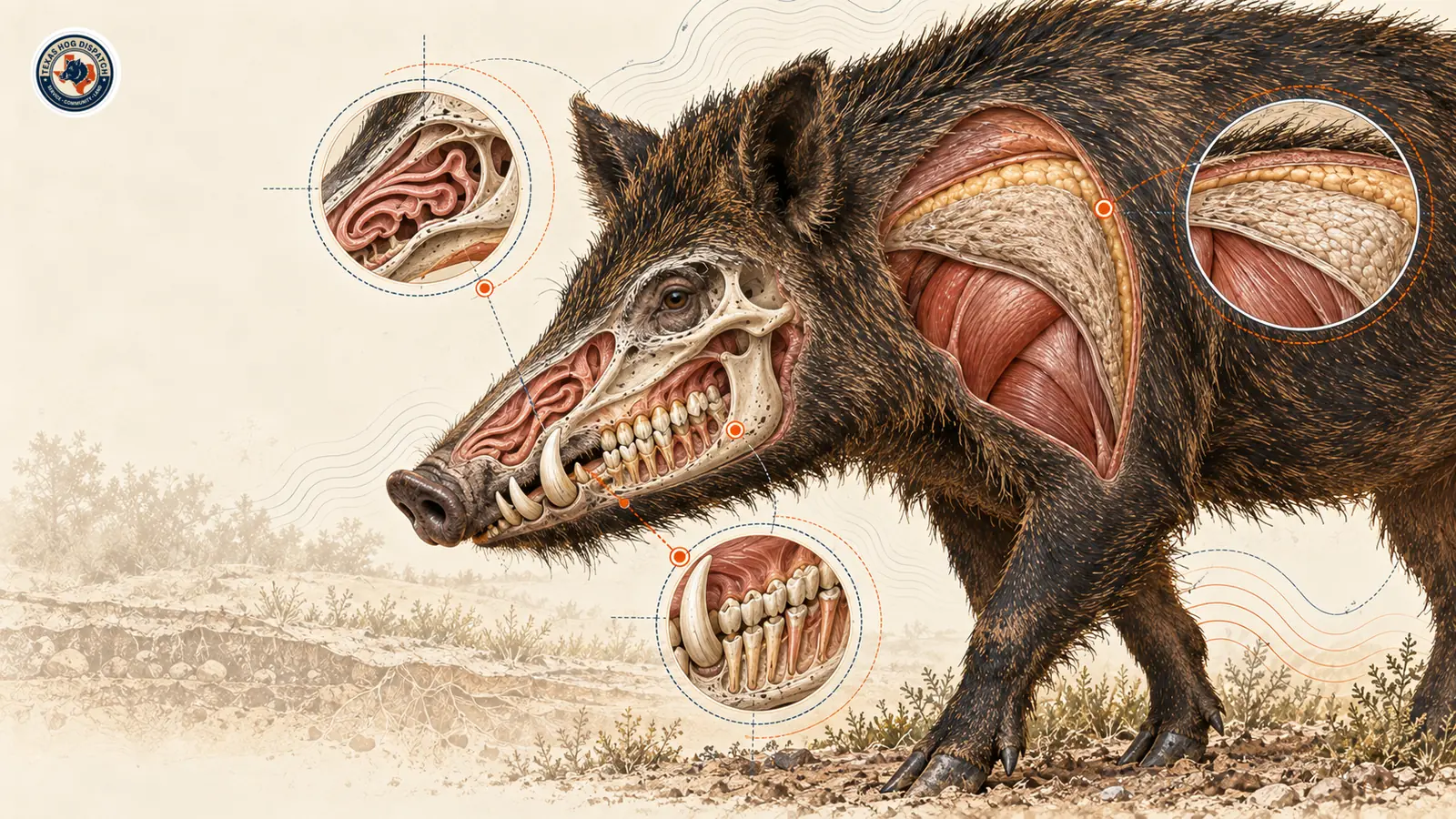
Picture the snout pressing into damp soil. The visible disk is only the contact surface of a larger apparatus.
What the evidence shows
Mobile soft tissues, a supporting rostral bone, a long facial skeleton, sensory nerves, and muscles coordinate nose, jaw, head, and neck. Rooting is both physical excavation and sensory investigation. Calling the animal a bulldozer captures the displaced soil but misses the discrimination that guides it.
The skull houses nasal passages and turbinates, the braincase, jaws, and tooth roots. Chewing draws on the masseter and temporalis; neck and axial muscles position and stabilize the head. Forelimbs support the front of the body while hindlimbs propel it. These familiar mammalian functions do not supply a measured “lifting capacity.” A large head, a robust neck, and dramatic video are not a force-platform experiment, and bite pressure in pounds per square inch cannot be inferred from body mass or tusk length.
An adult normally has 44 permanent teeth: on each side, upper and lower jaws each carry three incisors, one canine, four premolars, and three molars. Incisors crop and manipulate; cheek teeth crush and grind; canines form the tusks. Both sexes have canines, and mature males generally have larger, differently curved ones. Male canine growth and wear interact, and sows' canine roots can close with age. A tusk displayed outside the mouth is only part of the tooth.
The shoulder shield lies beneath the skin over the lateral shoulder musculature, especially in mature males. It is not a separate bony plate. Its development, thickness, and extent vary with age, size, condition, and season. The protective interpretation is consistent with male fighting and injury distribution.
The skeleton is an even-toed ungulate framework with four digits on each foot. The central pair primarily bears weight; the shorter lateral digits are the dewclaws. Soft ground and gait affect whether all four register in a track. Seven cervical vertebrae fit the usual mammalian plan, while thoracic, lumbar, and tail counts vary. Pig metapodials remain separate rather than forming the fused cannon bone familiar in cattle.
Research behind this chapter: 4 sources. View research notes ↓
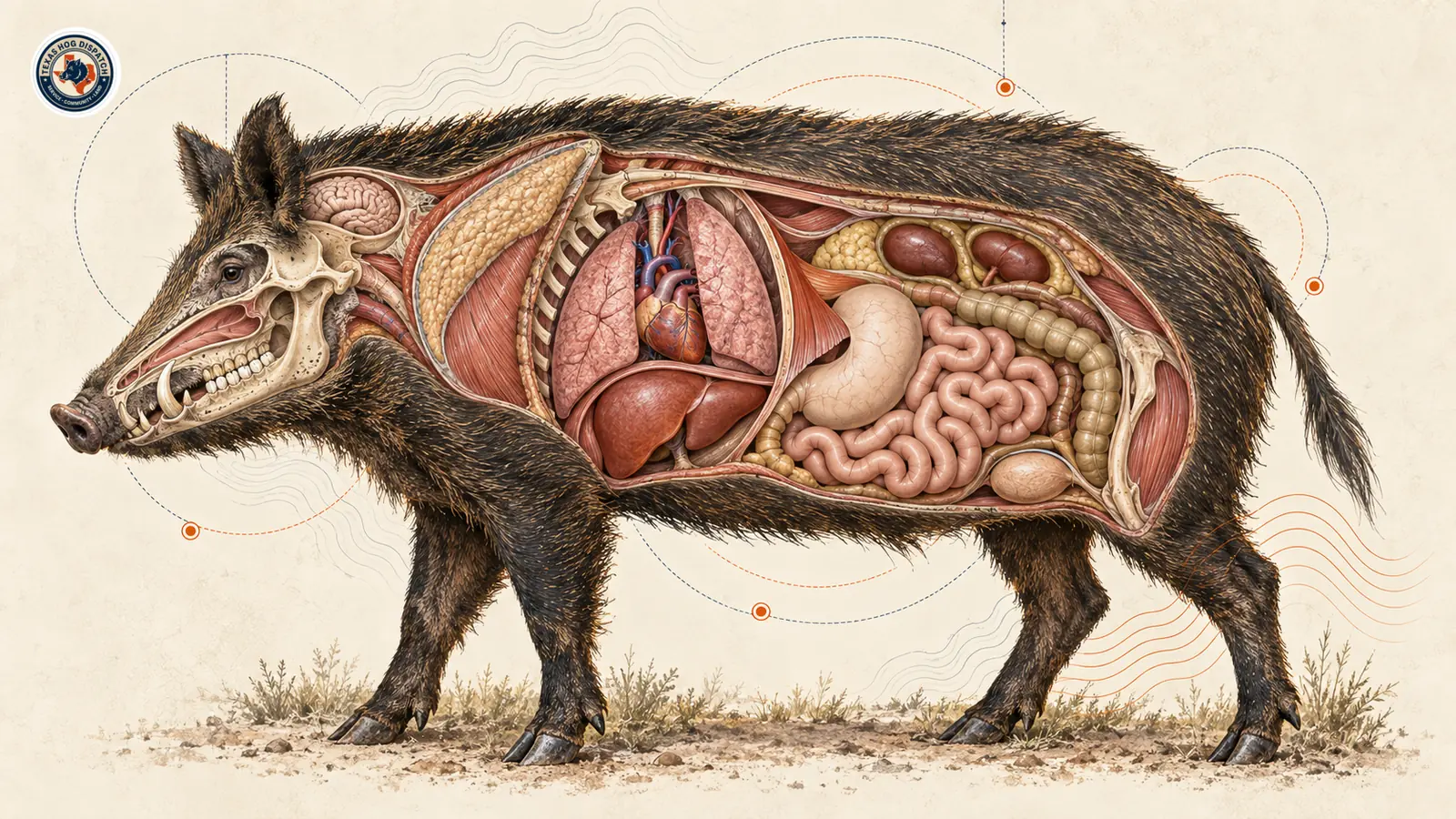
The cutaway figure
1. Snout and nasal system
Rostral disk, nasal cavity and turbinates, and the tactile and olfactory pathways that serve them. The snout contacts the substrate while odor and touch contribute different information. No smell-distance halo is shown, because no qualifying fixed-distance field experiment was recovered (C16).
2. Skull and jaws
Elongated facial bones, the braincase, jaw joints, and tooth roots, with the masseter and temporalis driving chewing. Skull architecture is not a bite force: no pounds-per-square-inch value is defensible from these structures (C10).
3. Teeth and tusks
The normal adult formula totals 44 permanent teeth, with canines in both sexes. Growth and wear interact, so exposed tusk length is not a simple clock (C07, C08, C53).
4. Shoulder shield
Variable tissue beneath the skin over the shoulder musculature, most developed in mature males. It is not a separate bony plate, and skin, fat, and shield thickness must be labeled separately (C09).
5. Heart and lungs
A four-chambered heart with systemic and pulmonary circulation, paired lobed lungs, and a diaphragm — ordinary mammalian circulation and respiration. Organ mass depends on body size and condition, so no universal organ dimensions are given (C13).
6. Single stomach
Pigs are monogastric. There is no rumen and no ruminant cud-chewing system; the stomach has glandular regions and follows the esophagus directly (C14).
7. Intestines and hindgut
Duodenum, jejunum, ileum, cecum, coiled colon, and rectum combine enzymatic digestion and absorption with microbial fermentation. Fiber use is not zero, but it is not a cow's foregut system either (C14).
8. Feet
Four digits per foot, with the central pair chiefly supporting weight and the shorter lateral digits forming dewclaws. Whether all four register in a track varies with soil and gait (C11).
Texas consequence
A single neat bone or rib total is inappropriate for every Texas animal, and neither is a single “standard hog” diagram. Sex, age, condition, and population history all change what a given carcass or track actually shows.
Evidence boundary
The organ inventory below is an educational organ-system list, not a surgical atlas or an assertion that every microscopic structure has been surveyed in free-ranging Texas pigs. Quantitative organ dimensions are deliberately not scaled from one domestic breed onto an imaginary average Texas hog; the detailed atlas route is the veterinary reference S34.
“Grows continuously” must not become “gets visibly longer at a fixed monthly rate forever” (C53), and no recovered primary test supports a stated bite force or lifting capacity (C10).
A normal adult dentition totals 44 permanent teeth.
Evidence boundary: Missing or broken teeth and age affect an individual count. Claim C07 is rated Verified for the normal formula, not for every animal examined.
- Scientific ReviewS01 · evidence class SYNTHESIS · Worldwide, with substantial U.S. material
The popular claim: “The shoulder shield is bulletproof armor.”
The defensible correction: It is variable subcutaneous tissue over the shoulder musculature, not a shell. A mean of 22 mm in the cited synthesis is not a Texas standard, and the two-inch bulletproof image is rejected (C09).
Research notes and sources
This material documents how the chapter was checked.
Evidence used in this chapter (4)
- Scientific ReviewS01 · evidence class SYNTHESIS · Worldwide, with substantial U.S. material
- Scientific ReviewS15 · evidence class COMP-ANAT/GEN
- Scientific ReviewS16 · evidence class COMP-ANAT/GEN
- Scientific ReviewS34 · evidence class TECH/GUIDANCE
Claim-by-claim audit (10)
- C06
Claim assessed: Snout, skull, jaw, and neck form an excavation and feeding apparatus.
Limit on Texas interpretation: Structural function does not quantify maximum strength.
Confidence: Verified — Directly established for the stated structure, sample, or study result. Does not imply statewide universality.
Sources: S01, S15, S16
- C07
Claim assessed: Normal permanent dentition totals 44 teeth.
Limit on Texas interpretation: Individual missing or broken teeth and age alter actual counts.
Confidence: Verified — Directly established for the stated structure, sample, or study result. Does not imply statewide universality.
Sources: S01
- C08
Claim assessed: Both sexes have tusks; male growth and wear differ from female development.
Limit on Texas interpretation: A fixed visible monthly increase or lifelong female growth is unjustified.
Confidence: Supported but Conditional — Credible evidence, with meaningful context, population, design, or transfer limits.
Sources: S01
- C09
Claim assessed: Mature male shoulder shields vary; they are subcutaneous tissue.
Limit on Texas interpretation: A mean of 22 mm in the cited synthesis is not a Texas standard; “two-inch bulletproof armor” is rejected.
Confidence: Supported but Conditional — Credible evidence, with meaningful context, population, design, or transfer limits.
Sources: S01
- C10
Claim assessed: A precise wild-hog bite force or lifting capacity is known statewide.
Limit on Texas interpretation: No suitable primary performance test was recovered; do not convert skull robustness into PSI.
Confidence: Unsupported/Overbroad — No defensible support located for the stated precision or universality, or the wording exceeds the evidence.
Sources: S01
- C11
Claim assessed: Four digits per foot, mainly the central pair supporting weight; axial bone counts vary.
Limit on Texas interpretation: Tracks depend on soil and gait; avoid one universal bone count.
Confidence: Verified — Directly established for the stated structure, sample, or study result. Does not imply statewide universality.
Sources: S01
- C12
Claim assessed: The snout has specialized tactile and neural representation.
Limit on Texas interpretation: Anatomical specialization is not measured field sensation or an IQ score.
Confidence: Supported but Conditional — Credible evidence, with meaningful context, population, design, or transfer limits.
Sources: S01, S15, S16
- C13
Claim assessed: The internal body follows the porcine mammalian organ plan.
Limit on Texas interpretation: Organ mass/dimensions cannot be assigned to all Texas animals.
Confidence: Verified — Directly established for the stated structure, sample, or study result. Does not imply statewide universality.
Sources: S01, S34
- C14
Claim assessed: Pigs are monogastric omnivores with hindgut fermentation.
Limit on Texas interpretation: Neither ruminants nor incapable of using fiber.
Confidence: Verified — Directly established for the stated structure, sample, or study result. Does not imply statewide universality.
Sources: S01
- C53
Claim assessed: A tusk grows exactly six millimeters visibly each month.
Limit on Texas interpretation: Tooth production differs from exposed length; population and wear matter.
Confidence: Unsupported/Overbroad — No defensible support located for the stated precision or universality, or the wording exceeds the evidence.
Sources: S01
Original sources and studies (4)
- S01. Mayer, J. J., & Brisbin, I. L., Jr. (eds.). (2009). Wild Pigs: Biology, Damage, Control Techniques and Management. Savannah River National Laboratory, SRNL-RP-2009-00869.Open the original source: https://sti.srs.gov/fulltext/SRNL-RP-2009-00869.pdf
- S15. Ritter, C., et al. (2021). An isomorphic three-dimensional cortical model of the pig rostrum. Journal of Comparative Neurology, 529(8), 2070–2090.Open the original source: https://doi.org/10.1002/cne.25073
- S16. Ritter, C., Eigen, L., Deiringer, N., Laubscher, L., & Brecht, M. (2023). Coevolution of rostrum and brain in pig species. Journal of Comparative Neurology, 531(7), 775–789.Open the original source: https://doi.org/10.1002/cne.25461
- S34. Swindle, M. M., & Smith, A. C. (eds.). (2016). Swine in the Laboratory: Surgery, Anesthesia, Imaging, and Experimental Techniques, 3rd ed.Open the original source: https://www.routledge.com/Swine-in-the-Laboratory-Surgery-Anesthesia-Imaging-and-Experimental-Techniques-Third-Edition/Swindle-Smith/p/book/9780429098017