The Boundary Problem
Public land trapping and private-property hog damage keep showing up in the same places, years apart. Here's what the record actually shows.
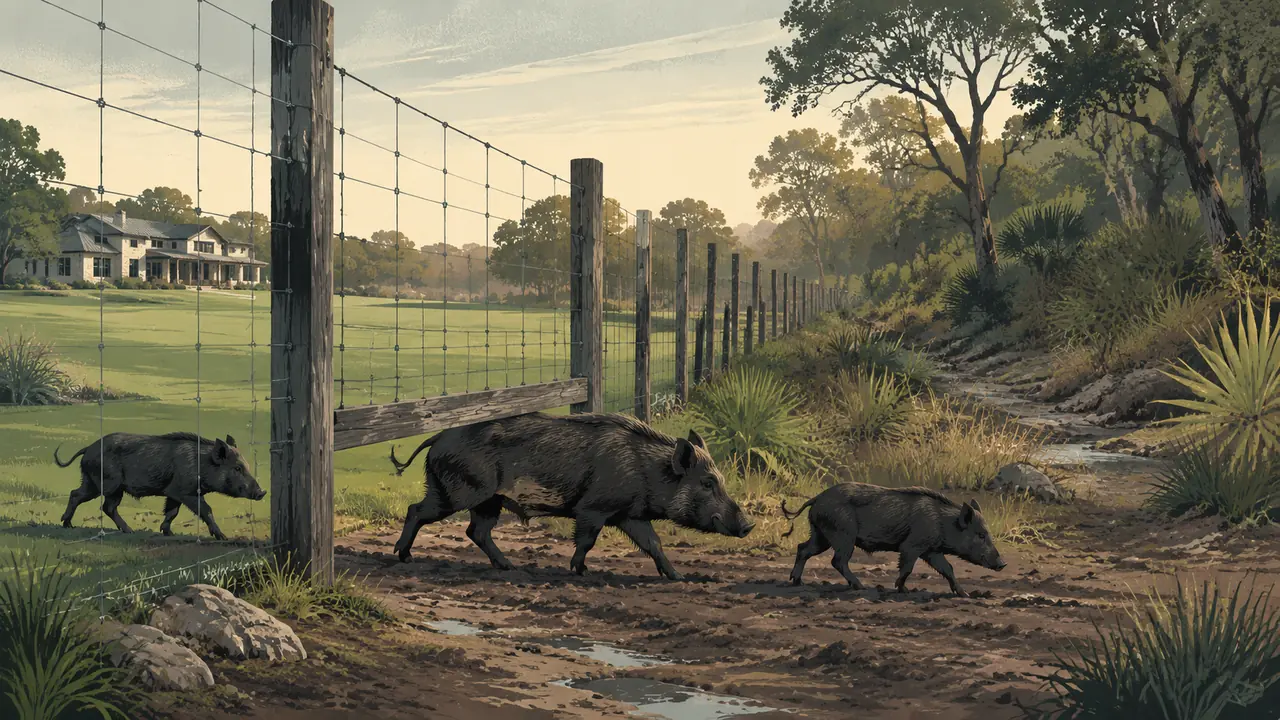
Why This Page Exists
Local governments across Texas have run funded, sustained trapping programs on public land for over a decade. Residents in the neighborhoods next door keep reporting the same unresolved damage anyway — sometimes for years, sometimes for the program's entire runtime. This page documents six verified cases where those two facts sit side by side, plus what officials and researchers have already said, in writing, about why.
Six Verified Cases
Presented chronologically, oldest first. Every entry links its primary source — news coverage of record, an official government document, or a peer-reviewed study.
Case 1Arlington, Tarrant County
City of Arlington / Arlington Animal Services
Public program
Ongoing trapping at River Legacy Park, the city landfill, and Parkway North since at least 2010 (63 hogs caught in 2010; 15–30/year since 2012; ~90 caught Oct 2021–Feb 2022; still active as of Nov 2023).
Private-side pattern
Parkway North residents report recurring yard damage in the same window, year after year. Field operations manager Ray Rentschler: “We've had the hogs here since at least 2010.” Resident Sazama, Nov 2023: “It's going to be a forever thing.”
- NBC 5 DFW (Nov 2014)www.nbcdfw.com/news/local/feral-pigs-going-hog-wild-in-arlington/108763/
- Dallas News (Feb 2022)www.dallasnews.com/news/2022/02/11/feral-hogs-tearing-up-yards-in-arlington-neighborhood/
- KERA News (Nov 2023)www.keranews.org/environment-nature/2023-11-13/its-going-to-be-a-forever-thing-north-arlington-neighborhood-battles-yearly-visits-by-feral-hogs
Case 2Austin, Travis County
Austin Water Wildland Conservation Division
Public program
Trapping on Water Quality Protection Lands and Balcones Canyonlands Preserve for over 15 years as of 2023 (75–150 hogs removed annually).
Private-side pattern
Lakewood neighborhood, adjacent to the managed land, reported hog visits several times a week, ~$1,000 in landscaping damage (Nov 2017). Austin Water's own program fact sheet states directly: “When they can migrate from an area with an active trap into areas without a management program, they are able to reproduce and quickly return to areas where they have been removed.”
- Austin American-Statesman (Nov 2023)www.statesman.com/story/news/state/2023/11/21/wild-hogs-feral-pigs-texas-invasive-species-size/71666094007/
- Austin Water official program fact sheetservices.austintexas.gov/edims/document.cfm?id=352944
- CBS Austin (Nov 2017 coverage, referenced in KXAN Oct 2020 report)www.kxan.com/news/local/austin/concerns-about-feral-hog-encounters-sparked-by-austin-animal-protection-officers-injury/
Case 3Addicks/Barker Reservoirs, Harris County
Harris County Precinct 3 (2014) and U.S. Army Corps of Engineers (2019–present)
Public program
Harris County Precinct 3 ran a funded trapping program at Addicks and Barker Reservoirs in 2014, donating meat to the Houston Food Bank. USACE Galveston District launched its own annual Feral Hog Management Program and trapping-permit system at the same reservoirs in August 2019, still active today.
Private-side pattern
Green Trails and neighboring subdivisions bordering these same reservoirs continued reporting active hog damage as recently as July 2026 — over a decade after public trapping first began at this location.
- Houston Chronicle (2014)www.houstonchronicle.com/news/houston-texas/houston/article/Feral-hog-capture-program-aims-to-protect-5792140.php
- USACE Galveston District official press release (Aug 2019)www.swg.usace.army.mil/Media/News-Releases/Article/1927655/addicks-and-barker-reservoirs-launch-feral-hog-management-program-and-permit-dr/
- FOX 26 Houston (Jul 2026, also featured on our News page)www.fox26houston.com/news/hundreds-wild-hogs-from-george-bush-park-creating-havoc-westside-neighborhood
Case 4San Diego County, California
USDA APHIS Wildlife Services / San Diego State University (Intergovernmental Pig Group)
Public program
Beginning in 2009, eleven government, tribal, and water-district land managers formed an all-lands eradication partnership. USDA Wildlife Services began large-scale removal in summer 2014; San Diego State University ran an independent camera-trap monitoring program (June 2014–January 2016, 285 cameras, 54,420 camera-nights) alongside it.
Private-side pattern
This is the one case in this set where outcome data — not just a removal count — was actually measured and published. The peer-reviewed occupancy study found site usage by feral swine declined substantially over the monitoring period, with rising probability of local absence. The authors are careful to note this measured a decline, not necessarily that removal caused it — but it's a genuine model for what independent, structured before/after monitoring looks like.
- San Diego Management and Monitoring Program — project recordwww.sdmmp.com/
- Biological Invasions (Springer) — peer-reviewed occupancy studylink.springer.com/article/10.1007/s10530-017-1579-x
Case 5Harris County Precinct 4 — First Agreement
Harris County Commissioners Court
Public program
Harris County Commissioners Court approved a no-cost trapping agreement with Theodis Daniel for Precinct 4 property, filed Sept. 8, 2025, passed Sept. 18, 2025, running through Dec. 31, 2028. (File #25-5974, Interlocal Agreement, Status: Passed.)
- Harris County Legistar official record — File #25-5974harriscountytx.legistar.com/gateway.aspx?m=l&id=/matter.aspx?key=39941
Case 6Harris County Precinct 4 — Second Agreement
Harris County Commissioners Court
Public program
A second Precinct 4 agreement, this time with Ricky DeMann, approved March 19, 2026, running through Dec. 31, 2031 — filed roughly six months after the first agreement, while resident complaints (Green Trails, near George Bush Park) were ongoing and unresolved.
- Harris County Legistar official record — File #26-1953harriscountytx.legistar.com/LegislationDetail.aspx?ID=7950645&GUID=A28022D3-4FF0-40E4-9632-5B26CE97A16B&FullText=1
What the Research Already Says
This pattern isn't just anecdotal. In April 2025, USDA researchers McKee, DeLay, Mooney, and Shwiff published a peer-reviewed study in PLOS ONE finding that neighboring landowners' actions are significantly associated with wild pig presence and financial losses on adjacent properties — and that the effects of management programs extend beyond the specific area being managed. Their conclusion: holistic control efforts need to account for these spatial effects to be effective.
Citation and scope note
McKee, S.C., DeLay, N.D., Mooney, D.F., & Shwiff, S.A. (2025). “Externalities in wild pig damages on U.S. crop and livestock farms: The role of landowner actions and landscape heterogeneity.” PLOS ONE, 20(4), e0320316. DOI: 10.1371/journal.pone.0320316
This study examined crop and livestock farms specifically. We're citing it here as supporting evidence for the general spatial-management principle, not as a direct study of suburban neighborhoods.
Why Outcome Data Like This Is Rare
San Diego is the exception, not the rule, and that's not an accident — it's a documented pattern in the research itself. A 2024 systematic review of 209 wild pig damage studies, published in the same journal as the San Diego study, found that 84% of damage assessments were purely qualitative, and only a small fraction combined population data with quantified damage measurements. The review's own authors concluded the field needs to start measuring population and damage together, before and after management, to actually know what works.
Citation
Cook, S.M., VerCauteren, K.C., Pepin, K.M., & Snow, N.P. (2024). "What is known, unknown, and needed to be known about damage caused by wild pigs." Biological Invasions. DOI: 10.1007/s10530-024-03263-z
Texas has actually done this measurement before — it's just rare. A Texas Department of Agriculture-funded pilot project spanning Hill, Navarro, Titus, Camp, and Matagorda Counties removed 3,799 hogs over two years and documented an estimated $1.4 million reduction in damage — $389.70 saved per hog removed. That figure comes from the Texas House Committee on Agriculture and Livestock's own January 2015 interim report to the 84th Legislature, which also stated plainly: "Current abatement techniques such as exclusion, snares, cage traps, shooting, and aerial hunting have proved largely ineffective in controlling and reducing the feral hog population across this state... they are all outmatched by the pace in which feral hogs are able to reproduce."
Texas House Committee on Agriculture and Livestock, Interim Report to the 84th Legislature, January 2015
What This Page Does Not Claim
We have not found — and are not aware of — any published before-and-after data proving that public-land trapping programs fail to reduce nearby private-property damage. What the record above shows is that funded public programs and unresolved private-side complaints have coexisted, sometimes for over a decade, in the same locations. That's a documented pattern worth understanding. It is not proof that any specific program has failed, and we're not presenting it as one.
Add or Correct a Case
Have a case that fits this pattern, or a correction to one of the six above? Send it to data@texashogdispatch.com with the location and its primary source, or use the report link below.