Texas Hog Dispatch · Educational research
Inside the Texas Wild Hog
What a Texas wild hog actually is, organ by organ and behavior by behavior, with every claim tied to a named source and an evidence class.
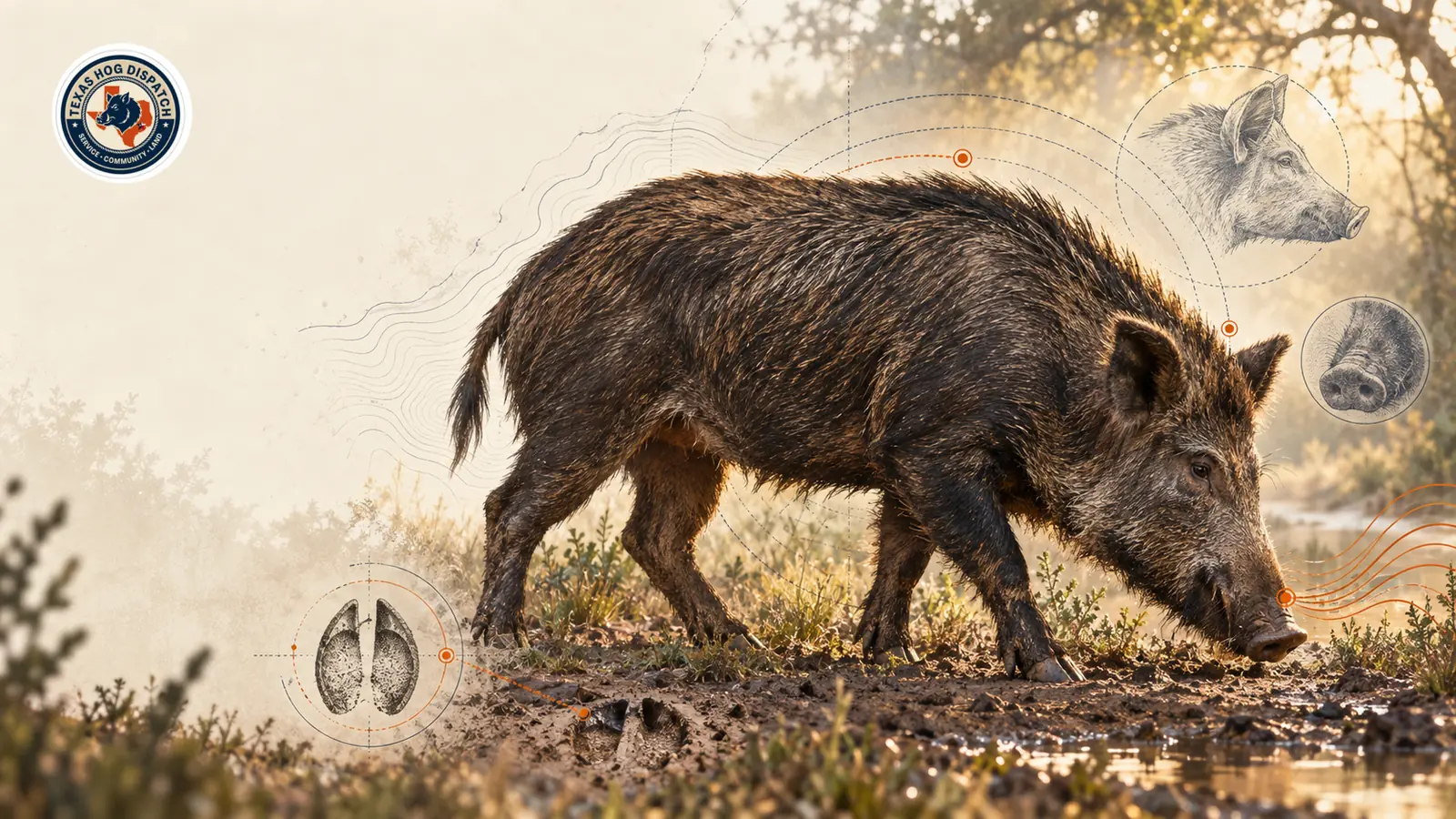
The central finding is variation
Texas wild hogs are neither barn pigs with every laboratory result transferred onto them, nor unchanged European wild boars. They are a mixed, locally variable population, and the honest answer to many popular questions is that it depends on the animal, the place, and the season.
Throughout this section, capability is not intent. Showing that an animal can do something is not a claim that it usually does, or that it will do it to you.
The ten chapters
- Chapter 1Several Histories in One AnimalTaxonomy, domestication, and feralization in Texas wild pigs: what genetics can establish about ancestry, and what a photograph of a hog cannot.
- Chapter 2From Bristle to Bone: The Working BodySnout, skull, dentition, tusks, shoulder shield, and organ systems of Texas wild pigs, with the bite-force, armor, and tusk-growth overclaims separated from the anatomy.
- Chapter 3Inside the Sensory WorldSmell, touch, hearing, vision, and taste in pigs — what controlled experiments measured, and why no fixed smell distance or eyesight value belongs in a Texas hog story.
- Chapter 4Learning Without an Intelligence League TableWhat controlled work shows about pig learning, memory, novelty, and fear — and why a declining trap catch is not proof that every survivor learned.
- Chapter 5Heat, Mud, Water, and the Texas DayThermoregulation, wallowing, shade, and water in Texas hogs: the defensible sweating formulation, what a heat-chamber experiment shows, and why no single lethal temperature exists.
- Chapter 6Bedding, Travel, and What Disturbance ChangesHome range, activity timing, swimming, corridors, and responses to disturbance in Texas wild pigs, with the estimator and nighttime-only data limits stated.
- Chapter 7The Sounder and the BoarKinship, group composition, leadership, and communication in Texas sounders — and why a single camera detection is not a social biography.
- Chapter 8Eating the LandscapeOmnivory, rooting, digestion, and the limits of stomach-content evidence in Texas wild pigs, including the South Texas carcass-investigation result.
- Chapter 9The Next GenerationReproductive timing, multiple paternity, juvenile survival, and a defensible population accounting for Texas wild pigs — without the doubling myth.
- Chapter 10Encounters and Disease Interfaces, Without FolkloreEncounter circumstances, injury potential, vehicle collisions, and disease exposure pathways for Texas wild pigs — with the missing denominators named.
A widely repeated 30–35 mph maximum is not supported here by a standardized primary speed test.
Evidence boundary: Published popular values lack stated timing, surface, distance, and individual context, so no numerical comparison with a human sprinter is offered (C52).
The popular claim: “Hogs reliably sprint 30 or 35 mph.”
The defensible correction: An exact standardized maximum was not established in this review. No defensible primary speed test was recovered (C52).
How to read the evidence labels
Each page carries the plain-language label a reader sees plus the exact evidence class and confidence value from the underlying review, so nothing is smoothed over.
- Verified
- Directly established for the stated structure, sample, or study result. Does not imply statewide universality.
- Supported but Conditional
- Credible evidence, with meaningful context, population, design, or transfer limits.
- Strong Inference
- Consistent biological reasoning supported by adjacent evidence; not directly tested for the exact Texas claim.
- Working Hypothesis
- Plausible, testable explanation with inadequate direct evidence.
- Unsupported/Overbroad
- No defensible support located for the stated precision or universality, or the wording exceeds the evidence.
Research notes and limits of this review
This is a critical narrative review, not a preregistered systematic review, and not a claim that every relevant publication has been recovered.
A source located is not necessarily a source examined in full. Each source entry states what was actually inspected.
“Not established here” means the reviewed evidence does not justify the claim. It does not prove that no study exists anywhere.
Texas field evidence, other North American field evidence, Eurasian wild-boar field evidence, domestic-pig laboratory work, comparative anatomy and genetics, scientific reviews, and technical guidance are not interchangeable. A Texas university affiliation does not turn a domestic-pig experiment into Texas wild-hog field evidence.