Inside the Texas Wild Hog
Bedding, Travel, and What Disturbance Changes
Home range, activity timing, swimming, corridors, and responses to disturbance in Texas wild pigs, with the estimator and nighttime-only data limits stated.
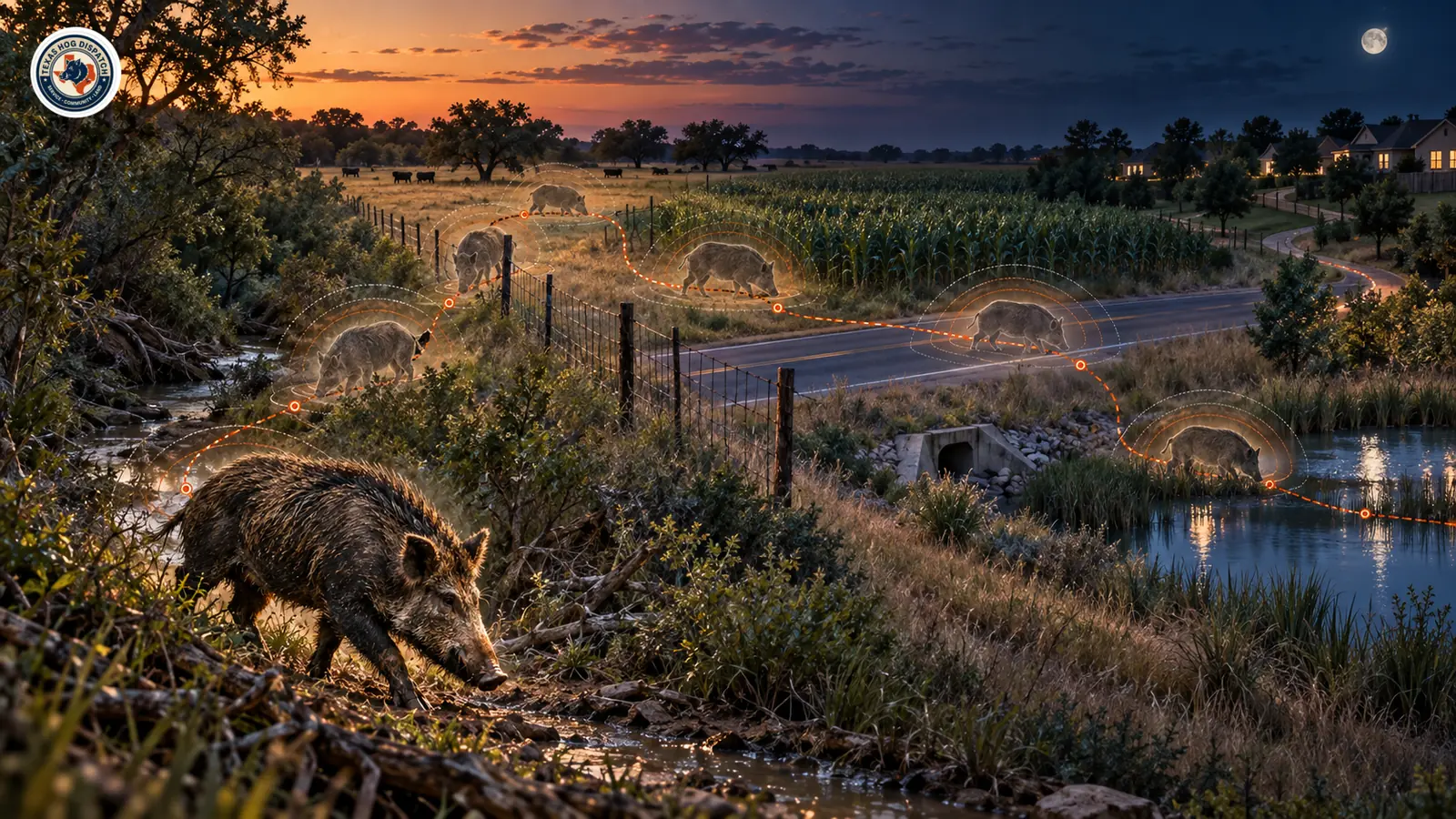
Imagine the same brush patch functioning as midday shelter, as the edge of a feeding route, and as a place to rest near water.
What the evidence shows
Habitat is a changing set of opportunities, not merely a colored polygon labeled “hog country.” Bedding cover, food, thermal conditions, disturbance, reproduction, and water can pull an animal in different directions.
Hogs often show substantial nighttime activity, especially under heat or human pressure, but daytime activity is real. One large movement synthesis restricted its analyzed fixes to 6 p.m.–8 a.m., which makes it unsuitable as independent proof of a full-day nocturnality percentage. Home-range area is not daily travel distance, maximum separation between fixes is not distance walked, and a minimum convex polygon and a utilization-distribution estimator measure space differently.
East Texas mine telemetry found resident use of reclaimed habitat rather than the expected night-only visits from outside. Desert telemetry documented much larger ranges in a different landscape. The comparison shows that one statewide acreage prescription is untenable, although differing samples and estimators mean it is not a controlled climate experiment.
Pigs can swim. Observations of crossings support that basic ability; exceptional distance reports are not standardized maximum-endurance trials. Water should not be drawn as an absolute dispersal barrier, but swimming ability does not guarantee survival across a flooded, fast-flowing, or heavily trafficked waterway.
Disturbance separates into four different outcomes: an immediate escape response, a shift in the next night's activity, permanent dispersal, and population decline. South Texas GPS work found more movement during aerial gunning without corresponding evidence of changed home- or core-range size before versus after. European radiotelemetry likewise produced more nuanced results than “hunting makes boar nocturnal and scatters them everywhere”; season and hunting modality matter.
Research behind this chapter: 12 sources. View research notes ↓
Texas consequence
A corridor can be inferred from repeated travel observations. It should not be drawn through a suburban creek merely because the map looks connected — that remains a working hypothesis until tracks, repeated detections, or telemetry support it.
Whole-sounder removal has empirical support, including comparative work in South Carolina and trapping trials in Oklahoma. Neither location is Texas, and density change, percentage removed, time per capture, and welfare performance are distinct outcomes.
Evidence boundary
Dogs combine pursuit, noise, close approach, and possible physical confrontation, and no Texas experiment isolating dog pursuit from other disturbance was recovered (C41). No universal annual removal threshold is supported (C44). A trap's apparent superiority also depends on placement, observation, operator effort, alternative food, and which animals remain available to catch.
In one East Texas mine study, mean annual ranges were 6.5 km² for females and 15.8 km² for males.
Evidence boundary: That is about 1,606 and 3,904 acres by unit conversion. Range area is not daily travel or defended territory, and the study covered 16 radio-tagged pigs in one altered landscape.
- Texas Field StudyS24 · evidence class TX-FIELD · Freestone County mine; 16 radio-tagged pigs
The popular claim: “Texas hogs are strictly nocturnal.”
The defensible correction: Activity is plastic, and nighttime-only data cannot prove a full-day percentage. The large movement synthesis analyzed fixes only between 6 p.m. and 8 a.m. (C37).
Research notes and sources
This material documents how the chapter was checked.
Evidence used in this chapter (12)
- Scientific ReviewS01 · evidence class SYNTHESIS · Worldwide, with substantial U.S. material
- North American FieldS23 · evidence class NA-FIELD · Six-state pool including a Texas component; Texas n not extracted
- Texas Field StudyS24 · evidence class TX-FIELD · Freestone County mine; 16 radio-tagged pigs
- Texas Field StudyS25 · evidence class TX-FIELD · Davis Mountains, Trans-Pecos
- Texas Field StudyS26 · evidence class TX-FIELD · Two southern Texas sites; 25 collared adults
- North American FieldS27 · evidence class NA-FIELD · Oklahoma
- Texas Field StudyS28 · evidence class TX-FIELD · East and Southeast Texas; 30 replicates per treatment; 86 sera
- North American FieldS29 · evidence class NA-FIELD · South Carolina
- Field Study — Eurasian wild boarS31 · evidence class WB-FIELD · Germany
- Scientific ReviewS32 · evidence class SYNTHESIS · Europe
- North American FieldS33 · evidence class NA-FIELD · South Carolina
- Texas Field StudyS41 · evidence class TX-FIELD · Texas Panhandle
Claim-by-claim audit (9)
- C36
Claim assessed: Home range differs by setting, sex, and analytical scale.
Limit on Texas interpretation: Range area is not daily travel, and estimators differ.
Confidence: Supported but Conditional — Credible evidence, with meaningful context, population, design, or transfer limits.
Sources: S24, S25, S23
- C37
Claim assessed: Texas hogs are strictly nocturnal.
Limit on Texas interpretation: Activity is plastic; nighttime-filtered data cannot determine full-day percentages.
Confidence: Unsupported/Overbroad — No defensible support located for the stated precision or universality, or the wording exceeds the evidence.
Sources: S24, S31, S23
- C38
Claim assessed: Urban creek lines are established hog corridors.
Limit on Texas interpretation: No representative local test was recovered; map continuity alone is insufficient.
Confidence: Working Hypothesis — Plausible, testable explanation with inadequate direct evidence.
Sources: S24
- C39
Claim assessed: Hogs swim; a universal maximum distance or speed is established.
Limit on Texas interpretation: Basic ability is supported; a standardized endurance ceiling was not recovered.
Confidence: Unsupported/Overbroad — No defensible support located for the stated precision or universality, or the wording exceeds the evidence.
Sources: S01
- C40
Claim assessed: Hunting or aerial removal always permanently scatters survivors.
Limit on Texas interpretation: Immediate movement, range shift, and permanent dispersal differ.
Confidence: Unsupported/Overbroad — No defensible support located for the stated precision or universality, or the wording exceeds the evidence.
Sources: S26, S31
- C41
Claim assessed: Dog pursuit has a known universal Texas displacement effect.
Limit on Texas interpretation: No isolated Texas dog-pursuit experiment was recovered.
Confidence: Working Hypothesis — Plausible, testable explanation with inadequate direct evidence.
Sources: S01, S31
- C42
Claim assessed: Failure to enter a trap proves learning or exceptional intelligence.
Limit on Texas interpretation: Alternative food, access, male presence, and local depletion confound interpretation.
Confidence: Unsupported/Overbroad — No defensible support located for the stated precision or universality, or the wording exceeds the evidence.
Sources: S28, S33
- C43
Claim assessed: Whole-sounder strategies can improve population reduction.
Limit on Texas interpretation: Site, effort, immigration, and metrics matter; not necessarily cheaper per pig.
Confidence: Supported but Conditional — Credible evidence, with meaningful context, population, design, or transfer limits.
Sources: S27, S29
- C44
Claim assessed: Exactly 70% annual removal always prevents growth.
Limit on Texas interpretation: It depends on recruitment, immigration, timing, and how the population is defined.
Confidence: Unsupported/Overbroad — No defensible support located for the stated precision or universality, or the wording exceeds the evidence.
Sources: S29, S32
Original sources and studies (12)
- S01. Mayer, J. J., & Brisbin, I. L., Jr. (eds.). (2009). Wild Pigs: Biology, Damage, Control Techniques and Management. Savannah River National Laboratory, SRNL-RP-2009-00869.Open the original source: https://sti.srs.gov/fulltext/SRNL-RP-2009-00869.pdf
- S23. Kay, S. L., et al. (2017). Quantifying drivers of wild pig movement across multiple spatial and temporal scales. Movement Ecology.Open the original source: https://link.springer.com/article/10.1186/s40462-017-0105-1
- S24. Mersinger, R. C., & Silvy, N. J. (2007). Range size, habitat use, and dial activity of feral hogs on reclaimed surface-mined lands in east Texas. Human–Wildlife Conflicts, 1(2), 161–167.Open the original source: https://digitalcommons.usu.edu/hwi/vol1/iss2/13/
- S25. Adkins, R. N., & Harveson, L. A. (2007). Demographic and spatial characteristics of feral hogs in the Chihuahuan Desert, Texas. Human–Wildlife Conflicts, 1(2), 152–160.Open the original source: https://digitalcommons.usu.edu/hwi/vol1/iss2/12/
- S26. Campbell, T. A., Long, D. B., & Leland, B. R. (2010). Feral Swine Behavior Relative to Aerial Gunning in Southern Texas. Journal of Wildlife Management, 74(2), 337–341.Open the original source: https://digitalcommons.unl.edu/icwdm_usdanwrc/886/
- S27. Gaskamp, J. A., Gee, K. L., Campbell, T. A., Silvy, N. J., & Webb, S. L. (2021). Effectiveness and Efficiency of Corral Traps, Drop Nets and Suspended Traps for Capturing Wild Pigs (Sus scrofa). Animals, 11(6), 1565.Open the original source: https://www.mdpi.com/2076-2615/11/6/1565
- S28. Sumrall, S. A. (2011). Abatement Strategies and Disease Assessment for Feral Hogs in East Texas. PhD dissertation, Texas A&M University.Open the original source: https://oaktrust.library.tamu.edu/server/api/core/bitstreams/caa8ebc4-be90-4e98-aa46-abb8722129e7/content
- S29. Kilgo, J. C., et al. (2023). Assessing whole-sounder removal versus traditional control for reducing invasive wild pig (Sus scrofa) populations. Pest Management Science, 79, 3033–3042.Open the original source: https://research.fs.usda.gov/treesearch/66639
- S31. Keuling, O., Stier, N., & Roth, M. (2008). How does hunting influence activity and spatial usage in wild boar Sus scrofa L.? European Journal of Wildlife Research, 54, 729–737.Open the original source: https://link.springer.com/article/10.1007/s10344-008-0204-9
- S32. Massei, G., et al. (2015). Wild boar populations up, numbers of hunters down? A review of trends and implications for Europe. Pest Management Science.Open the original source: https://doi.org/10.1002/ps.3965
- S33. Brewer, S. M., Snow, N. P., & Beasley, J. C. (2026). Proximity to bait and social interactions influence individual wild pig (Sus scrofa) visitation at bait sites. Journal of Wildlife Management, 90(5), e70220.Open the original source: https://wildlife.onlinelibrary.wiley.com/doi/10.1002/jwmg.70220
- S41. Franckowiak, G. A., Torres-Poché, Z., & Poché, R. M. (2018). Activity Patterns by Feral Hogs in the Texas Panhandle. American Midland Naturalist, 180(2), 233–245.Open the original source: https://doi.org/10.1674/0003-0031-180.2.233