Inside the Texas Wild Hog
Inside the Sensory World
Smell, touch, hearing, vision, and taste in pigs — what controlled experiments measured, and why no fixed smell distance or eyesight value belongs in a Texas hog story.
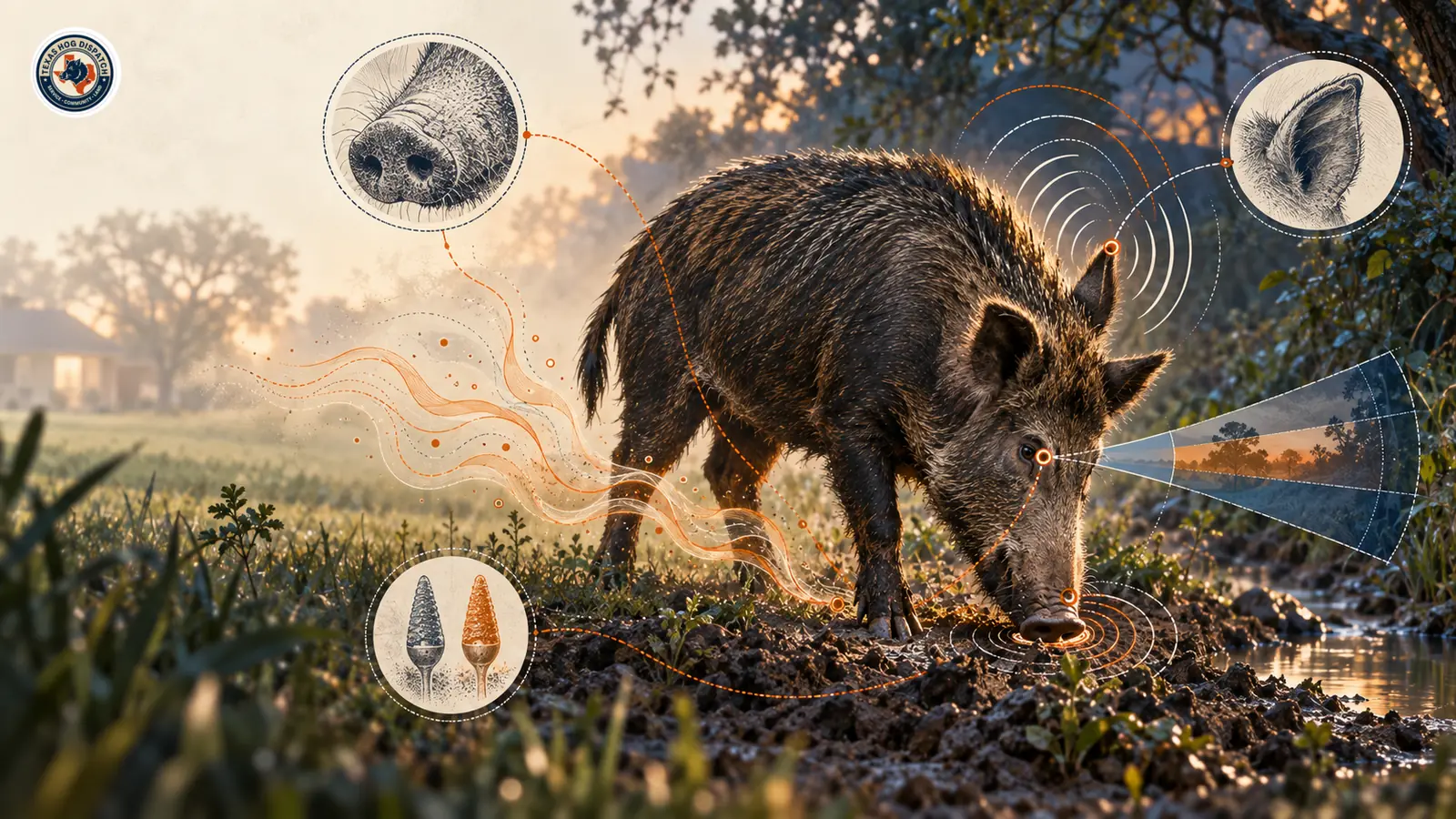
Imagine lowering your attention from the horizon to a ribbon of disturbed ground. For the hog, the snout is not just an air sampler: it contacts the substrate while odor and touch contribute different information.
What the evidence shows
Rostral neuroanatomy gives that image a physical basis. Comparative work links the form of the rostrum with a conspicuous cortical representation. It does not establish what a free-ranging Texas hog subjectively experiences.
Olfaction matters in foraging, social recognition, and reproduction. Domestic-pig experiments demonstrate odor discrimination and habituation: a pig can reduce investigation of a repeated odor and investigate a new one. In a separate laboratory tradition, piglets distinguished maternal from other sow odors. These are controlled tests of discrimination and learning, not demonstrations that a wild hog detects a person at a mile. Airflow, humidity, source strength, terrain, background odors, and the difference between detection and approach all matter, and genetic receptor diversity is not a measured smell-distance ruler.
Hearing has been measured with behavioral audiograms in domestic pigs. The result extends into ultrasound, but threshold curves depend on frequency and sound level. An animal hearing a loud tone is different from an animal hearing a quiet twig break at an unspecified distance.
Vision resists the shorthand “nearly blind.” Retinal experiments found two cone classes, and a separate juvenile-pig experiment measured patterned retinal responses. Neither lets anyone paint an exact Texas-hog point-of-view video. Color discrimination, visual acuity, motion sensitivity, field of view, and dim-light vision are separate properties.
Taste interacts with smell, texture, hunger, and prior experience. A controlled comparison of compounds sweet to people found that only some elicited the tested pig response, so a sweetener appealing to a person is not automatically an attractive hog bait. Touch includes the snout, lips, vibrissae, skin, and feet, which helps explain why a pig may investigate something by nudging or mouthing it rather than simply looking at it.
Research behind this chapter: 10 sources. View research notes ↓
Texas consequence
For Texas readers the practical consequence is interpretive: a hog reacting at the edge of a pasture tells you something reacted, not which sense was used or from how far. Wind, cover, and background odor differ between a coastal pasture, a brush line, and a suburban greenbelt.
Evidence boundary
Two cone classes support color discrimination but not a validated pig-view photograph (C22). Anesthetized retinal acuity is not awake recognition (C23). The audiogram sample was three domestic pigs (C18). No qualifying odor-range field experiment was recovered (C16).
A three-pig laboratory audiogram found hearing extending above the usual upper range of human hearing.
Evidence boundary: This is not a field hearing-distance test; measured thresholds depend on frequency and sound level (C18).
- Laboratory ResearchS12 · evidence class DOM-LAB
The popular claim: “A hog can smell a person from one fixed distance.”
The defensible correction: No qualifying fixed-distance field experiment was recovered. Folklore distances leave the odor source, wind, and detection threshold unspecified (C16).
Research notes and sources
This material documents how the chapter was checked.
Evidence used in this chapter (10)
- Scientific ReviewS01 · evidence class SYNTHESIS · Worldwide, with substantial U.S. material
- Laboratory ResearchS10 · evidence class DOM-LAB
- Laboratory ResearchS11 · evidence class DOM-LAB
- Laboratory ResearchS12 · evidence class DOM-LAB
- Laboratory ResearchS13 · evidence class DOM-LAB
- Laboratory ResearchS14 · evidence class DOM-LAB
- Scientific ReviewS15 · evidence class COMP-ANAT/GEN
- Scientific ReviewS16 · evidence class COMP-ANAT/GEN
- Scientific ReviewS17 · evidence class COMP-ANAT/GEN
- Laboratory ResearchS18 · evidence class DOM-LAB
Claim-by-claim audit (8)
- C12
Claim assessed: The snout has specialized tactile and neural representation.
Limit on Texas interpretation: Anatomical specialization is not measured field sensation or an IQ score.
Confidence: Supported but Conditional — Credible evidence, with meaningful context, population, design, or transfer limits.
Sources: S01, S15, S16
- C15
Claim assessed: Pigs discriminate odors and respond to repeated and novel odors.
Limit on Texas interpretation: 96 paired experimental units, not 192 independent trials; no wild detection distance.
Confidence: Verified — Directly established for the stated structure, sample, or study result. Does not imply statewide universality.
Sources: S10
- C16
Claim assessed: Wild hogs smell a human or food at one fixed distance.
Limit on Texas interpretation: No qualifying range experiment was recovered; odor source, wind, and threshold are unspecified in folklore.
Confidence: Unsupported/Overbroad — No defensible support located for the stated precision or universality, or the wording exceeds the evidence.
Sources: S10, S33
- C17
Claim assessed: Maternal odor discrimination and receptor diversity support olfactory sophistication.
Limit on Texas interpretation: Neither establishes superiority over dogs in every odor task.
Confidence: Supported but Conditional — Credible evidence, with meaningful context, population, design, or transfer limits.
Sources: S11, S17
- C18
Claim assessed: Domestic pigs detect sound over a broad frequency range.
Limit on Texas interpretation: Measured thresholds matter; this is not a field hearing-distance estimate.
Confidence: Supported but Conditional — Credible evidence, with meaningful context, population, design, or transfer limits.
Sources: S12
- C22
Claim assessed: Pigs are color-blind in the sense of seeing only gray.
Limit on Texas interpretation: Dichromacy supports color discrimination; the exact subjective appearance is unknown.
Confidence: Unsupported/Overbroad — No defensible support located for the stated precision or universality, or the wording exceeds the evidence.
Sources: S13
- C23
Claim assessed: “Nearly blind,” or one precise Texas-hog eyesight value, is established.
Limit on Texas interpretation: Anesthetized retinal acuity is not awake visual recognition; small related cohort.
Confidence: Unsupported/Overbroad — No defensible support located for the stated precision or universality, or the wording exceeds the evidence.
Sources: S14
- C24
Claim assessed: Human sweetness predicts hog food preference.
Limit on Texas interpretation: Only some tested compounds were effective; field intake has other drivers.
Confidence: Unsupported/Overbroad — No defensible support located for the stated precision or universality, or the wording exceeds the evidence.
Sources: S18
Original sources and studies (10)
- S01. Mayer, J. J., & Brisbin, I. L., Jr. (eds.). (2009). Wild Pigs: Biology, Damage, Control Techniques and Management. Savannah River National Laboratory, SRNL-RP-2009-00869.Open the original source: https://sti.srs.gov/fulltext/SRNL-RP-2009-00869.pdf
- S10. Rørvang, M. V., et al. (2023). Odor exploration behavior of domestic pig (Sus scrofa) as indicator of enriching properties of odors. Frontiers in Behavioral Neuroscience, 17, 1173298.Open the original source: https://www.frontiersin.org/journals/behavioral-neuroscience/articles/10.3389/fnbeh.2023.1173298/full
- S11. Morrow-Tesch, J., & McGlone, J. J. (1990). Sources of maternal odors and the development of odor preferences in baby pigs. Journal of Animal Science, 68(11), 3563–3571.Open the original source: https://doi.org/10.2527/1990.68113563x
- S12. Heffner, R. S., & Heffner, H. E. (1990). Hearing in domestic pigs (Sus scrofa) and goats (Capra hircus). Hearing Research, 48(3), 231–240.Open the original source: https://pubmed.ncbi.nlm.nih.gov/2272932/
- S13. Neitz, J., & Jacobs, G. H. (1989). Spectral sensitivity of cones in an ungulate. Visual Neuroscience, 2(2), 97–100.Open the original source: https://doi.org/10.1017/S0952523800011949
- S14. Ventrella, D., et al. (2022). The p-ERG spatial acuity in the biomedical pig under physiological conditions. Scientific Reports, 12.Open the original source: https://pmc.ncbi.nlm.nih.gov/articles/PMC9474814/
- S15. Ritter, C., et al. (2021). An isomorphic three-dimensional cortical model of the pig rostrum. Journal of Comparative Neurology, 529(8), 2070–2090.Open the original source: https://doi.org/10.1002/cne.25073
- S16. Ritter, C., Eigen, L., Deiringer, N., Laubscher, L., & Brecht, M. (2023). Coevolution of rostrum and brain in pig species. Journal of Comparative Neurology, 531(7), 775–789.Open the original source: https://doi.org/10.1002/cne.25461
- S17. Kang, M., et al. (2023). Individual and population diversity of 20 representative olfactory receptor genes in pigs. Scientific Reports, 13.Open the original source: https://pmc.ncbi.nlm.nih.gov/articles/PMC10618239/
- S18. Nofre, C., Glaser, D., Tinti, J. M., & Wanner, M. (2002). Gustatory responses of pigs to sixty compounds tasting sweet to humans. Journal of Animal Physiology and Animal Nutrition, 86(3–4), 90–96.Open the original source: https://doi.org/10.1046/j.1439-0396.2002.00361.x