Inside the Texas Wild Hog
The Next Generation
Reproductive timing, multiple paternity, juvenile survival, and a defensible population accounting for Texas wild pigs — without the doubling myth.
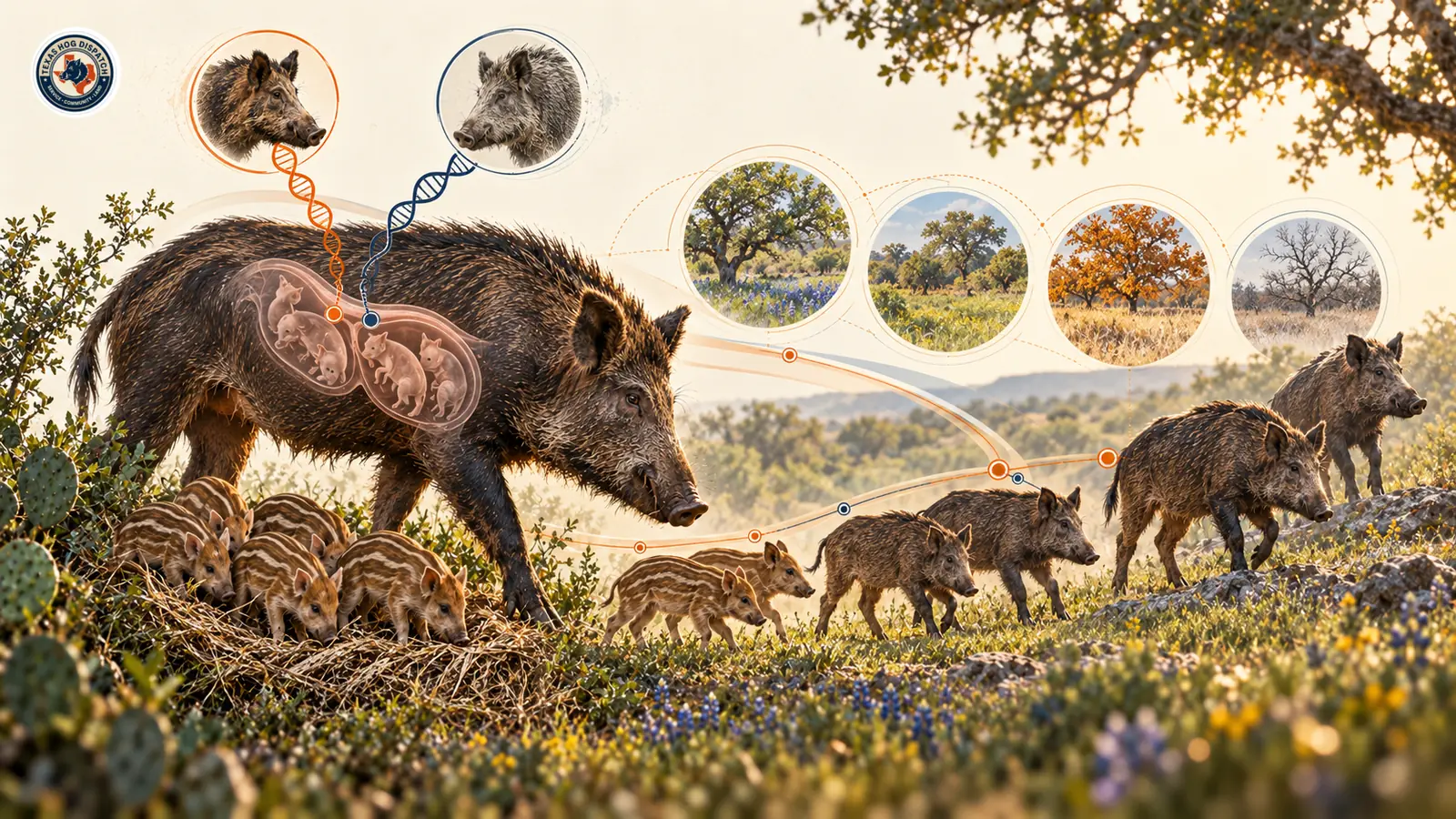
Imagine a litter as the opening of a demographic story rather than its final population count.
What the evidence shows
Texas microsatellite parentage work detected more than one sire in 21 of 64 litters. Multiple paternity is a litter-level finding; it is not the fraction of all Texas females that mate multiply.
Females can bear young within their first year under favorable circumstances, but nutritional condition and body development matter. Physiological puberty, first conception, and first successful litter are different milestones. Estrous cycles are roughly three weeks and gestation roughly four months — approximate biological intervals, not a guarantee of repeated successful pregnancies.
Southern Texas reproductive data show strong differences among ages, seasons, and locations. An adult sow's pregnancy status at one sampling occasion does not give her lifetime fecundity. Fetal litter size, births, nursing young, weaned recruits, and adults added to the population are different denominators.
Young piglets also face thermal exposure and limited reserves, so bedding and maternal behavior belong in any explanation of juvenile survival.
Research behind this chapter: 5 sources. View research notes ↓
Texas consequence
Mortality, removal, emigration, and immigration determine whether reproductive potential becomes growth. A defensible population accounting is: next population = current population + births − deaths + immigrants − emigrants.
Removing animals changes that balance, but claims that a fixed percentage must always be killed every year require a demographic model and assumptions about timing, recruitment, and immigration.
Evidence boundary
Multiplying maximum litter size by maximum litters and assuming every offspring survives produces an illustration of arithmetic, not a forecast (C34, C54). Juvenile survival is not a single stable statewide percentage; no representative estimate was recovered (C60). The 298 figure in the reproductive study is fetuses in a sex-ratio component, not 298 sows (S06).
Texas parentage work found more than one sire in 21 of 64 sampled litters.
Evidence boundary: That sample-level result — about 33% of those litters — is not an all-Texas frequency, and fetuses are not survivors (C33).
- Texas Field StudyS09 · evidence class TX-FIELD · Nine southern Texas sites; 64 litters
The popular claim: “Every sow produces two large surviving litters each year, so populations double on schedule.”
The defensible correction: Births, deaths, immigration, and emigration all matter. Regional Texas data show strong variation by age, season, and location, and litter size alone does not measure growth (C34, C54).
Research notes and sources
This material documents how the chapter was checked.
Evidence used in this chapter (5)
- Scientific ReviewS01 · evidence class SYNTHESIS · Worldwide, with substantial U.S. material
- Texas Field StudyS06 · evidence class TX-FIELD · Gulf Coast Prairies and western South Texas
- Texas Field StudyS09 · evidence class TX-FIELD · Nine southern Texas sites; 64 litters
- North American FieldS29 · evidence class NA-FIELD · South Carolina
- Scientific ReviewS32 · evidence class SYNTHESIS · Europe
Claim-by-claim audit (6)
- C31
Claim assessed: Puberty can occur within the first year; estrus about 21 days, gestation roughly four months.
Limit on Texas interpretation: Nutrition, sex, and social access affect first successful breeding.
Confidence: Supported but Conditional — Credible evidence, with meaningful context, population, design, or transfer limits.
Sources: S01, S06
- C33
Claim assessed: Multiple paternity occurs in Texas litters.
Limit on Texas interpretation: 21 of 64 litters — a sample-level 33%, not an all-Texas frequency; fetuses are not survivors.
Confidence: Verified — Directly established for the stated structure, sample, or study result. Does not imply statewide universality.
Sources: S09
- C34
Claim assessed: Every sow produces two large surviving litters annually, so the population necessarily doubles on schedule.
Limit on Texas interpretation: Births, deaths, and movement must all be counted.
Confidence: Unsupported/Overbroad — No defensible support located for the stated precision or universality, or the wording exceeds the evidence.
Sources: S06, S01
- C44
Claim assessed: Exactly 70% annual removal always prevents growth.
Limit on Texas interpretation: It depends on recruitment, immigration, timing, and how the population is defined.
Confidence: Unsupported/Overbroad — No defensible support located for the stated precision or universality, or the wording exceeds the evidence.
Sources: S29, S32
- C54
Claim assessed: A sow's litter size directly measures population growth.
Limit on Texas interpretation: Survival and immigration/emigration are additional variables.
Confidence: Unsupported/Overbroad — No defensible support located for the stated precision or universality, or the wording exceeds the evidence.
Sources: S06, S09
- C60
Claim assessed: Juvenile survival is a single stable statewide percentage.
Limit on Texas interpretation: Weather, condition, predation, disease, and removal vary; no representative estimate was recovered.
Confidence: Unsupported/Overbroad — No defensible support located for the stated precision or universality, or the wording exceeds the evidence.
Sources: S01, S06
Original sources and studies (5)
- S01. Mayer, J. J., & Brisbin, I. L., Jr. (eds.). (2009). Wild Pigs: Biology, Damage, Control Techniques and Management. Savannah River National Laboratory, SRNL-RP-2009-00869.Open the original source: https://sti.srs.gov/fulltext/SRNL-RP-2009-00869.pdf
- S06. Taylor, R. B., Hellgren, E. C., Gabor, T. M., & Ilse, L. M. (1998). Reproduction of Feral Pigs in Southern Texas. Journal of Mammalogy, 79(4), 1325–1331.Open the original source: https://academic.oup.com/jmammal/article-abstract/79/4/1325/846050
- S09. Delgado-Acevedo, J., et al. (2010). Promiscuous mating in feral pigs (Sus scrofa) from Texas, USA. Wildlife Research, 37, 539–546.Open the original source: https://doi.org/10.1071/WR10052
- S29. Kilgo, J. C., et al. (2023). Assessing whole-sounder removal versus traditional control for reducing invasive wild pig (Sus scrofa) populations. Pest Management Science, 79, 3033–3042.Open the original source: https://research.fs.usda.gov/treesearch/66639
- S32. Massei, G., et al. (2015). Wild boar populations up, numbers of hunters down? A review of trends and implications for Europe. Pest Management Science.Open the original source: https://doi.org/10.1002/ps.3965