Inside the Texas Wild Hog
Encounters and Disease Interfaces, Without Folklore
Encounter circumstances, injury potential, vehicle collisions, and disease exposure pathways for Texas wild pigs — with the missing denominators named.
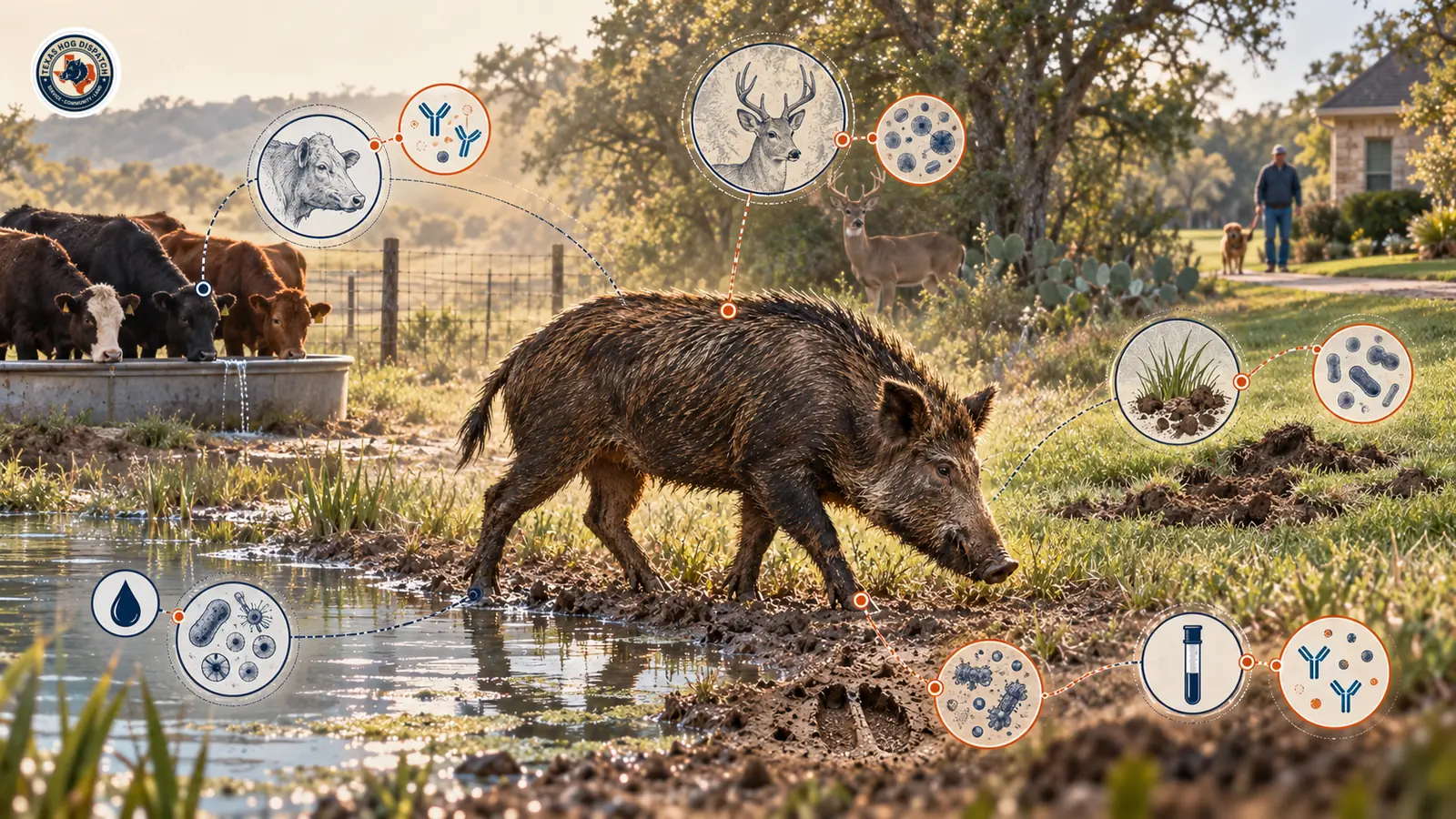
Imagine meeting a hog at close range in vegetation with no clear exit.
What the evidence shows
The scientifically useful questions are where it can escape, whether young are present, whether it is injured or pursued, and whether a dog is escalating the encounter. A categorical “friendly” or “aggressive” label supplies little guidance.
Serious and fatal attacks are documented. A worldwide fatality compilation is a collection of reported events, affected by reporting and ascertainment. It has no denominator of all hog encounters, visits to hog habitat, or people exposed in Texas, so it cannot yield a Texas per-encounter probability. Defensive behavior is important, but not every reported attack fits a single motive.
Vehicle collisions deserve separate treatment from attacks. An animal crossing a road has not necessarily charged a car. A 2026 South Carolina field experiment measured avoidance responses to vehicle lighting; it did not measure a proven statewide reduction in Texas crashes.
Disease risk depends on agent, route, host, and place. Blood or reproductive-fluid contact, raw or undercooked meat, contaminated environments, and exposure of dogs or livestock are different pathways. Antibodies indicate prior exposure; they do not by themselves show that an animal is currently shedding an agent. Healthy-looking pigs can still be infected. Current CDC guidance advises protective handling and thorough cooking, and warns that freezing, smoking, drying, or pickling does not reliably eliminate Brucella.
Research behind this chapter: 9 sources. View research notes ↓
Texas consequence
Guidance consistent with agency advice and this evidence is to give the animal distance and an exit, avoid approaching or feeding it, keep dogs controlled, and avoid cornering or pursuing an injured animal. Retreat toward a substantial barrier or an enclosed vehicle when feasible, and do not approach a hog merely because it appears still or wounded. Seek emergency help for an immediate threat or serious injury, and tell a clinician about wild-swine exposure following a bite, cut, or contaminated-fluid contact.
Drivers should maintain an appropriate stopping margin and stay alert for additional animals after the first one crosses. That is risk management, not a quantified guarantee or an endorsement of untested aftermarket lighting.
The 2026 Texas influenza paper concerns samples collected in 2022–2023 at one ranch. Its publication date does not turn them into a 2026 statewide prevalence estimate, and influenza-A seropositivity is not proof of active H5N1 infection. Older reports of brucellosis or pseudorabies likewise require their sampling dates and tests beside their percentages.
Evidence boundary
There is no well-tested universal distance, zigzag maneuver, or guaranteed tree-climbing escape rule in the reviewed evidence. No per-encounter attack probability for Texas can be calculated from a worldwide case compilation (C59). This page describes circumstances and exposure pathways; it is general education, not medical, legal, or safety advice, and not an emergency channel.
A healthy-looking wild pig can still carry pathogens.
Evidence boundary: Risk depends on agent, route, place, and exposure, and antibodies show prior exposure rather than current shedding. No zero-risk handling claim follows (C49).
- Scientific ReviewS36 · evidence class TECH/GUIDANCE
- Scientific ReviewS38 · evidence class SYNTHESIS
- Scientific ReviewS45 · evidence class TECH/GUIDANCE
The popular claim: “All hogs are aggressive” — or “attacks occur only when provoked.”
The defensible correction: Neither blanket claim is justified. Capability is not intent: documented injury potential does not establish that any individual animal intends to confront people (C45, C46).
Research notes and sources
This material documents how the chapter was checked.
Evidence used in this chapter (9)
- Texas Field StudyS28 · evidence class TX-FIELD · East and Southeast Texas; 30 replicates per treatment; 86 sera
- Texas Field StudyS30 · evidence class TX-FIELD · San Antonio Viejo Ranch, South Texas; 59 sites / 91 carcasses
- Scientific ReviewS35 · evidence class SYNTHESIS · Worldwide reported cases
- Scientific ReviewS36 · evidence class TECH/GUIDANCE
- Scientific ReviewS37 · evidence class TECH/GUIDANCE
- Scientific ReviewS38 · evidence class SYNTHESIS
- North American FieldS39 · evidence class NA-FIELD · South Carolina
- Texas Field StudyS40 · evidence class TX-FIELD · One north-central Texas ranch; 396 sera collected 2022–2023
- Scientific ReviewS45 · evidence class TECH/GUIDANCE
Claim-by-claim audit (8)
- C45
Claim assessed: Wild pigs can cause serious or fatal human injury.
Limit on Texas interpretation: Severity is documented; frequency per Texas encounter is unknown.
Confidence: Verified — Directly established for the stated structure, sample, or study result. Does not imply statewide universality.
Sources: S35
- C46
Claim assessed: All hogs are aggressive, or attacks are impossible unless provoked.
Limit on Texas interpretation: Motives and circumstances vary; neither blanket claim is justified.
Confidence: Unsupported/Overbroad — No defensible support located for the stated precision or universality, or the wording exceeds the evidence.
Sources: S35, S37
- C47
Claim assessed: Vehicle response can depend on lighting; lighting modifications guarantee fewer Texas crashes.
Limit on Texas interpretation: An avoidance surrogate in a small fleeing-group subset; the Texas crash outcome is untested.
Confidence: Supported but Conditional — Credible evidence, with meaningful context, population, design, or transfer limits.
Sources: S39
- C48
Claim assessed: South Texas pigs investigated conspecific carcasses without observed cannibalism.
Limit on Texas interpretation: It does not establish “never eat their own,” and no infection transmission was measured.
Confidence: Verified — Directly established for the stated structure, sample, or study result. Does not imply statewide universality.
Sources: S30
- C49
Claim assessed: Apparently healthy pigs can carry pathogens; exposure prevention matters.
Limit on Texas interpretation: Agent, route, and location specific; no zero-risk handling claim.
Confidence: Supported but Conditional — Credible evidence, with meaningful context, population, design, or transfer limits.
Sources: S36, S45, S38
- C50
Claim assessed: Texas influenza-A antibodies demonstrate active H5N1 or statewide 40% infection.
Limit on Texas interpretation: Neither follows from the assay, the sampling frame, or the dates.
Confidence: Unsupported/Overbroad — No defensible support located for the stated precision or universality, or the wording exceeds the evidence.
Sources: S40
- C51
Claim assessed: Pseudorabies and Brucella exposure was detected in the East Texas dissertation sample.
Limit on Texas interpretation: 86 sera from a historical captured sample; antibodies are not current infectiousness.
Confidence: Verified — Directly established for the stated structure, sample, or study result. Does not imply statewide universality.
Sources: S28
- C59
Claim assessed: The probability of attack per Texas encounter is known.
Limit on Texas interpretation: The case compilation lacks an exposure denominator; worldwide reports cannot be divided by Texas population.
Confidence: Unsupported/Overbroad — No defensible support located for the stated precision or universality, or the wording exceeds the evidence.
Sources: S35
Original sources and studies (9)
- S28. Sumrall, S. A. (2011). Abatement Strategies and Disease Assessment for Feral Hogs in East Texas. PhD dissertation, Texas A&M University.Open the original source: https://oaktrust.library.tamu.edu/server/api/core/bitstreams/caa8ebc4-be90-4e98-aa46-abb8722129e7/content
- S30. Leivers, S., Campbell, T., Bodenchuk, M., & Tomeček, J. (2023). Behavior of Wild Pigs toward Conspecific Carcasses: Implications for Disease Transmission in a Hot, Semiarid Climate. Transboundary and Emerging Diseases, 2023, 4195199.Open the original source: https://pmc.ncbi.nlm.nih.gov/articles/PMC12017100/
- S35. Mayer, J. J., Garabedian, J. E., & Kilgo, J. C. (2023). Human Fatalities Resulting from Wild Pig Attacks Worldwide: 2000–2019. Human–Wildlife Interactions, 17(1), Article 4.Open the original source: https://digitalcommons.usu.edu/hwi/vol17/iss1/4/
- S36. Centers for Disease Control and Prevention. (2026, June 2). Brucellosis and Animals.Open the original source: https://www.cdc.gov/brucellosis/php/animal-health/
- S37. West, B. C., Cooper, A. L., & Armstrong, J. B. (2009). Managing Wild Pigs: A Technical Guide. Human–Wildlife Interactions Monograph 1.Open the original source: https://www.aphis.usda.gov/sites/default/files/managing-feral-pigs.pdf
- S38. Meng, X.-J., Lindsay, D. S., & Sriranganathan, N. (2009). Wild boars as sources for infectious diseases in livestock and humans. Philosophical Transactions of the Royal Society B, 364, 2697–2707.Open the original source: https://pmc.ncbi.nlm.nih.gov/articles/PMC2865094/
- S39. Pakula, C. J., Guenin, S., Skaggs, J., Rhodes, O. E., Jr., & DeVault, T. L. (2026). Modified vehicle lighting reduces wildlife collision risk by enhancing deer and wild pig avoidance responses at night. Journal of Applied Ecology.Open the original source: https://besjournals.onlinelibrary.wiley.com/doi/10.1111/1365-2664.70431
- S40. Chalkowski, K., et al. (2026). Elevated Exposure to Influenza A Viruses in Wild Pigs (Sus scrofa), Texas, USA. Journal of Wildlife Diseases.Open the original source: https://doi.org/10.7589/jwd-d-25-00031
- S45. USDA Animal and Plant Health Inspection Service. (2026, June 9). Swine Brucellosis.Open the original source: https://www.aphis.usda.gov/livestock-poultry-disease/swine/swine-brucellosis