Inside the Texas Wild Hog
Heat, Mud, Water, and the Texas Day
Thermoregulation, wallowing, shade, and water in Texas hogs: the defensible sweating formulation, what a heat-chamber experiment shows, and why no single lethal temperature exists.
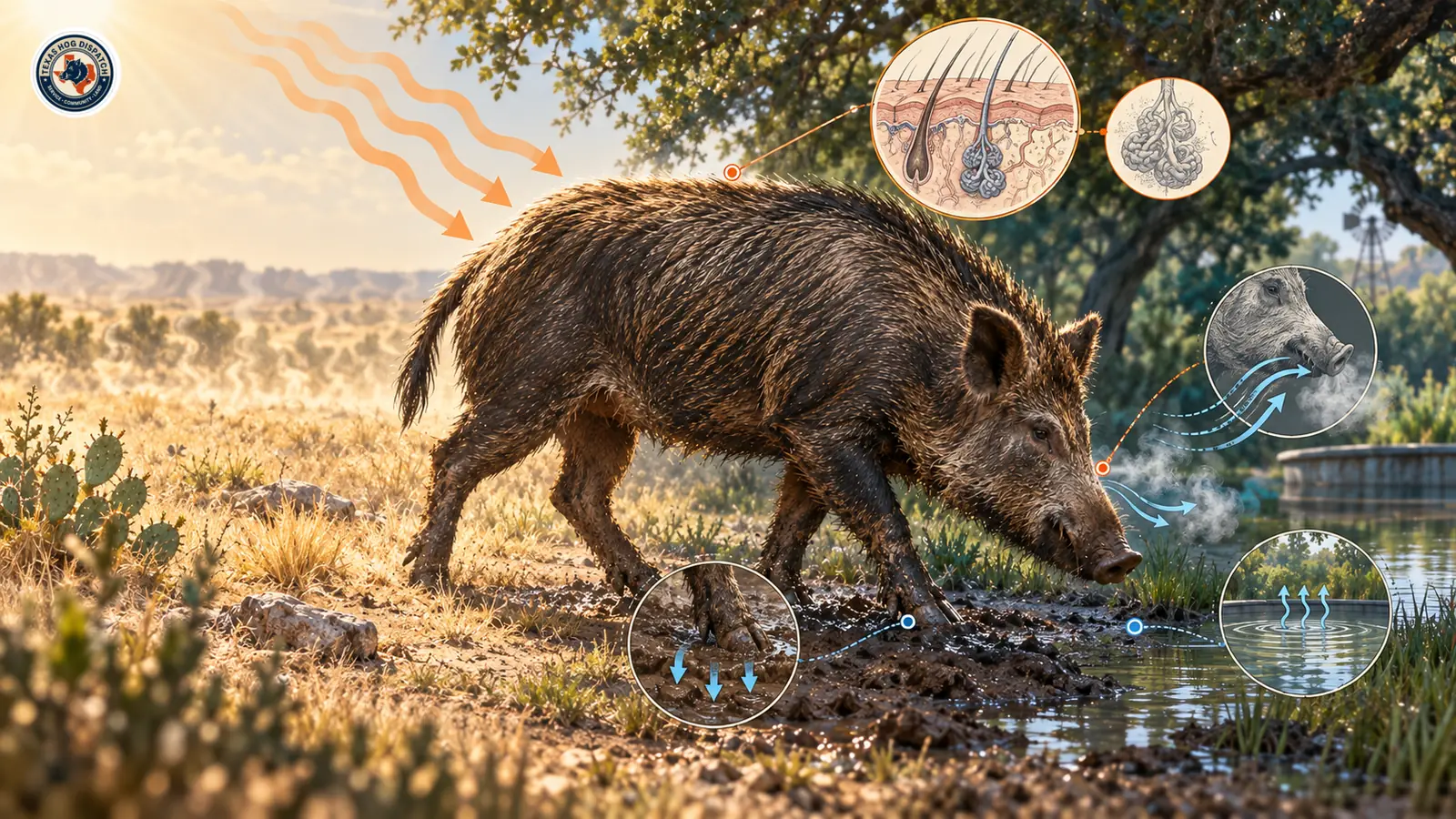
Picture a heavy-bodied animal at the edge of a stock tank as afternoon heat builds.
What the evidence shows
Shade reduces radiant heat gain; wetting and contact with cooler substrate can help lose heat; evaporation and respiratory cooling matter. These are parts of an energy and water budget, not decorative habits. Wallowing can also involve skin care, parasites, and social or comfort functions, so a mud-covered hog is not a thermometer with one interpretation.
The phrase “pigs have no sweat glands” is anatomically too strong. Glands and effective thermoregulatory sweating are different claims. The safer physiological statement is that pigs have limited capacity to cool themselves through sweating and rely heavily on behavioral and respiratory mechanisms.
Controlled domestic-pig heat exposure demonstrates increased respiratory and body-temperature responses and reduced feeding. A chamber experiment is evidence of mechanism; it does not establish that a free-ranging hog will die whenever a Texas weather station reports the chamber's air temperature. Shade, radiation, wind, humidity, water, acclimatization, mass, and activity change the exposure.
Young piglets face the opposite thermal problem as well: limited body reserves and exposure to cold or wet conditions. Bedding and maternal behavior belong in any explanation of juvenile survival. “Texas is warm” does not abolish cold stress, particularly in the Panhandle or during cold events.
Research behind this chapter: 6 sources. View research notes ↓
Texas consequence
In humid coastal landscapes, evaporation may be less effective; in semiarid South and West Texas, accessible water and thermal refuge can become limiting. Those are strong mechanistic inferences, and their numerical effect on Texas hog survival or daily drinking cannot be assigned without field measurements.
East Texas telemetry provides direct evidence that water and screening cover organize space use. A water point may concentrate animals, but concentrations on camera can reflect redistributed animals rather than population growth.
Evidence boundary
No universal lethal Texas air temperature is supported, and wallowing has no single purpose (C20). A fixed daily water requirement and all-weather dependence on one water point are unmeasured (C21). The regional numerical effect of humidity and drought on thermal load is a strong inference, not a measurement (C57).
“Pigs have no sweat glands” is too strong; limited effective sweating is the defensible formulation.
Evidence boundary: Glands and effective thermoregulatory sweating are different claims. Even the foundational synthesis contains this overstatement, which is why C19 is rated Unsupported/Overbroad.
- Scientific ReviewS01 · evidence class SYNTHESIS · Worldwide, with substantial U.S. material
- Laboratory ResearchS46 · evidence class DOM-LAB
The popular claim: “One Texas air temperature is universally lethal to hogs.”
The defensible correction: Exposure depends on shade, radiation, wind, humidity, water, condition, and activity. A chamber experiment measures mechanism, not an outdoor death threshold (C20).
Research notes and sources
This material documents how the chapter was checked.
Evidence used in this chapter (6)
- Scientific ReviewS01 · evidence class SYNTHESIS · Worldwide, with substantial U.S. material
- Scientific ReviewS21 · evidence class SYNTHESIS
- Laboratory ResearchS22 · evidence class DOM-LAB
- Texas Field StudyS24 · evidence class TX-FIELD · Freestone County mine; 16 radio-tagged pigs
- Texas Field StudyS25 · evidence class TX-FIELD · Davis Mountains, Trans-Pecos
- Laboratory ResearchS46 · evidence class DOM-LAB
Claim-by-claim audit (5)
- C19
Claim assessed: Pigs have no sweat glands whatsoever.
Limit on Texas interpretation: Limited effective sweating is the defensible formulation.
Confidence: Unsupported/Overbroad — No defensible support located for the stated precision or universality, or the wording exceeds the evidence.
Sources: S46, S01
- C20
Claim assessed: Heat exposure increases thermal strain; wallowing and shade can contribute to cooling.
Limit on Texas interpretation: No universal lethal Texas air temperature, and no single-purpose explanation for wallowing.
Confidence: Supported but Conditional — Credible evidence, with meaningful context, population, design, or transfer limits.
Sources: S22, S01, S21
- C21
Claim assessed: Water and thermal refuge influence Texas space use.
Limit on Texas interpretation: A fixed daily water requirement and all-weather dependence on one water point are unmeasured.
Confidence: Supported but Conditional — Credible evidence, with meaningful context, population, design, or transfer limits.
Sources: S24, S25, S01
- C34
Claim assessed: Every sow produces two large surviving litters annually, so the population necessarily doubles on schedule.
Limit on Texas interpretation: Births, deaths, and movement must all be counted.
Confidence: Unsupported/Overbroad — No defensible support located for the stated precision or universality, or the wording exceeds the evidence.
Sources: S06, S01
- C57
Claim assessed: Humidity and drought change the value of shade and water.
Limit on Texas interpretation: The physical mechanism is strong; the regional numerical effect is not measured here.
Confidence: Strong Inference — Consistent biological reasoning supported by adjacent evidence; not directly tested for the exact Texas claim.
Sources: S01, S22, S24, S25
Original sources and studies (6)
- S01. Mayer, J. J., & Brisbin, I. L., Jr. (eds.). (2009). Wild Pigs: Biology, Damage, Control Techniques and Management. Savannah River National Laboratory, SRNL-RP-2009-00869.Open the original source: https://sti.srs.gov/fulltext/SRNL-RP-2009-00869.pdf
- S21. Bracke, M. B. M. (2011). Review of wallowing in pigs: Description of the behaviour and its motivational basis. Applied Animal Behaviour Science, 132(1–2), 1–13.Open the original source: https://doi.org/10.1016/j.applanim.2011.01.002
- S22. Mayorga, E. J., et al. (2024). Therapeutic effects of mitoquinol during an acute heat stress challenge in growing gilts. Journal of Animal Science, 102, skae250.Open the original source: https://pmc.ncbi.nlm.nih.gov/articles/PMC11439150/
- S24. Mersinger, R. C., & Silvy, N. J. (2007). Range size, habitat use, and dial activity of feral hogs on reclaimed surface-mined lands in east Texas. Human–Wildlife Conflicts, 1(2), 161–167.Open the original source: https://digitalcommons.usu.edu/hwi/vol1/iss2/13/
- S25. Adkins, R. N., & Harveson, L. A. (2007). Demographic and spatial characteristics of feral hogs in the Chihuahuan Desert, Texas. Human–Wildlife Conflicts, 1(2), 152–160.Open the original source: https://digitalcommons.usu.edu/hwi/vol1/iss2/12/
- S46. Ingram, D. L. (1965). Evaporative Cooling in the Pig. Nature, 207, 415–416.Open the original source: https://www.nature.com/articles/207415a0