The Catchability Gap: Do Feral Hogs Learn to Avoid Traps?
A removal count tells us what was caught. Understanding what remains takes a different kind of evidence.
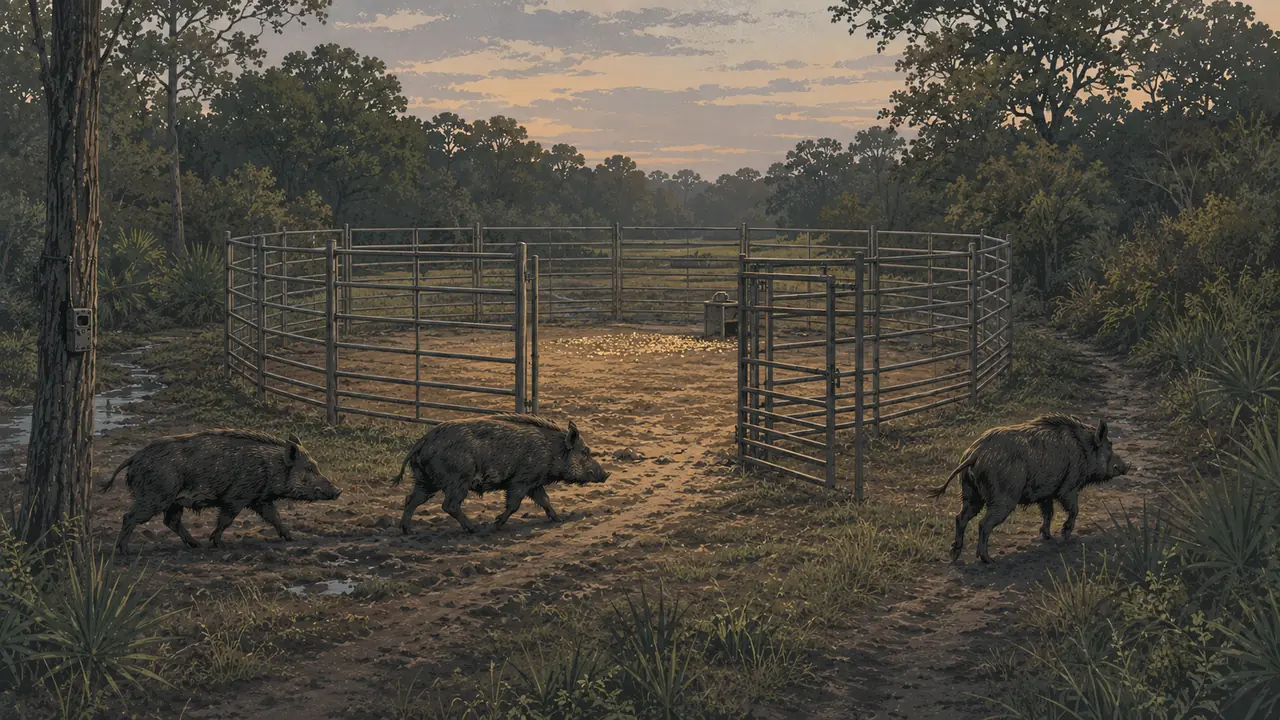
Count the catch.
Study the survivors.
Wild pigs with previous trapping experience have been measured using bait sites less. That raises a larger question: could repeated removal also change which kinds of pigs remain—and eventually which traits they pass on? [1]
This review found evidence for experience-associated avoidance. It found no published direct test of the complete inherited-catchability mechanism in wild pigs. That unresolved connection is what we call the Catchability Gap.
Three ways the problem could change.
The same pig behaves differently.
A negative encounter can be followed by greater avoidance. The direct pig evidence here concerns lower bait-site use after trapping and release; it does not establish inheritance. [1]
Different pigs make up the remaining population.
If consistently easier-to-catch animals are removed first, less-catchable animals could become a larger share of survivors. This could happen without learning or genetic change. It is a hypothesis about selective removal, not a finding established for wild pigs by this review.
A heritable trait becomes more common across generations.
This requires inherited differences and unequal reproductive contribution. Capture vulnerability responded to selective breeding in largemouth bass. Applying that result to wild pigs remains an untested inference. [2]
These processes can overlap. Evidence for one does not establish the others.
Left behind does not always mean gone.
A newly published, peer-reviewed accepted manuscript followed 18 GPS-collared pigs in Alabama after their sounders were removed. Their early movements showed attachment to familiar areas, followed by changing movement patterns influenced by the group’s original adult composition. [9]
An earlier paper from this research program found that isolated females generally stayed near trapping locations and rarely dispersed during the 30-day observation period. [10]
What this changes: we should not assume every survivor immediately scatters. Neither paper demonstrates inherited trap avoidance or guarantees successful recapture.
Study design matters
What the studies actually show.
Direct pig evidence, comparisons from other species, and the limits of each.
Wild pigs · Texas & Alabama · 2022Previous trapping experience was associated with less bait-site use.
Snow and colleagues reported 30–31% greater bait-site use over 17 days among pigs without prior negative exposure than among previously trapped-and-released pigs. [1]
This is a relative difference in bait-site use, not a capture rate, a percentage of pigs made uncatchable, or an inherited effect. The study also found a strong association with dry versus wet conditions.
Largemouth bass · Breeding experiment · 2009Vulnerability to capture can have an inherited component.
Philipp and colleagues bred lines with high and low vulnerability to angling across three generations. The lines diverged, with estimated realized heritability of 0.146. This demonstrates a response to artificial selection in these bass. [2]
That estimate is specific to the study and trait. It is not a probability that a pig inherits avoidance, and angling vulnerability is not equivalent to hog-trap vulnerability.
Largemouth bass · Field comparison · 2015Fishing history was associated with vulnerability in wild populations.
Nesting males in lightly or unexploited lakes were more vulnerable to angling than males in more heavily fished populations. This is consistent with the breeding experiment. [3]
A comparison among lakes cannot independently separate inheritance from learning, environmental effects, or other population differences.
Smallmouth bass · Long-term suppression · 2025Fish in a removal lake fled sooner from an approaching threat.
After 24 years of targeted removal, smallmouth bass in one lake had greater flight-initiation distances than fish in comparison lakes. Native pumpkinseed sunfish, which were not targeted, showed no substantial difference among lakes. The authors proposed that removal may have favored more wary survivors. [4]
The behavioral comparison does not isolate a genetic cause. It supports investigating selective removal, without establishing that process in wild pigs.
Smallmouth bass · Genomic evidence · 2025Sustained suppression was linked to evolutionary change.
Genomic research in the same suppression system documented changes associated with earlier maturation and faster growth. The population response complicated the effort to suppress the invader. [5]
This concerns life history and genetic change, not demonstrated evolution of catchability. The two smallmouth-bass papers examine the same system and are not independent replications.
Wild boar · France · 2011Hunting pressure can impose selection in the same species.
A 22-year study found birth dates advancing by as much as 12 days. Under higher hunting pressure, earlier birth was associated with a greater chance of breeding in the first year of life. [6]
This is selection on birth timing in Sus scrofa. It does not show that the timing shift was genetic, or that capture vulnerability changed.
Wild boar · Japan · 2020Catchability changes with conditions, too.
Yokoyama and colleagues combined camera data and harvest records to estimate density, habitat preference, and trap catchability. Estimated catchability varied seasonally, with relatively high winter values. [11]
Catchability already has a research literature. The missing test here concerns selective removal and inherited change in wild pigs—not whether anyone has ever studied catchability.
Why this matters in the field.
In a 2026 bioeconomic model, greater assumed avoidance made keeping pig numbers low while remaining economically viable more difficult. Avoidance was a fixed parameter tested at different levels; the model did not measure learning or evolution in the field. [8]
The next useful question is not just “How many did we remove?” It is “What do we know about the ones still there?”
Our practical interpretation is to pair removal totals with information about effort, remaining activity, and changing conditions. A lower catch can have more than one explanation.
For landowners
Ask how remaining activity and recurring damage will be checked after a removal.
For operators
Record effort, trap entry, incomplete captures, method changes, and follow-up observations.
For program managers
Read catch totals alongside monitoring. Falling catches alone do not distinguish population reduction from reduced vulnerability.
For researchers
Separate an animal’s exposure history from persistent individual differences, then test whether those differences are inherited.
These are monitoring priorities drawn from the review, not a validated field protocol. TPWD identifies trapping as an effective tool for large-scale reduction and describes camera-assisted whole-sounder capture. The open research question does not establish that control fails. [12]
The question a study would need to answer.
Does sustained removal consistently favor less-catchable wild pigs—and, if capture vulnerability is partly inherited, does that change later generations?
Four links needed to test the inherited mechanism
- Repeatable differences. Establish whether individual pigs differ consistently in capture vulnerability before negative exposure.
- Unequal removal. Test whether more-vulnerable pigs are removed more often, accounting for effort, method, age, sex, social group, habitat, and conditions.
- Inheritance and reproduction. Use pedigree, common-environment, or genomic approaches to test heritability, while measuring which survivors contribute offspring.
- Change over generations. Compare trajectories under sustained removal with credible comparison populations, separating inherited change from learning, immigration, and population turnover.
This is our proposed evidence framework. Research on hunting and evolution cautions that environmental effects and the timing, intensity, and selectivity of harvest must be considered before attributing a trend to evolution. [7]
Scope, search date, and limitations
This is a targeted evidence review, not an original experiment, peer-reviewed THD study, or systematic review. The August 24 draft was rechecked September 2, 2026 using targeted web searches, journal and institutional records, abstracts, and available full texts.
Searches combined wild pig, feral swine, wild boar, and Sus scrofa with catchability, trapping, avoidance, behavior, heritability, selection, and evolution, including searches for 2025–2026 research. Full text was not accessible for every source.
We identified no published direct test of the complete inherited-catchability mechanism in wild pigs within this search. That does not establish that no relevant study or unpublished dataset exists. Findings from bass, European boar, or Alabama pigs are not local measurements for Harris or Montgomery County.
Sources · 13 references
- Snow et al. (2022). Dry and unwary are best conditions for baiting wild pigs (Sus scrofa). Applied Animal Behaviour Science, 257, 105777.
- Philipp et al. (2009). Selection for vulnerability to angling in largemouth bass. Transactions of the American Fisheries Society, 138, 189–199.
- Philipp et al. (2015). Fisheries-induced evolution in largemouth bass: Linking vulnerability to angling, parental care, and fitness. American Fisheries Society Symposium, 82, 223–234.
- Detmer et al. (2025). Long-term removal increases risk aversion of a widely introduced predatory fish. Biological Invasions, 27, 146.
- Zarri et al. (2025). Eradication efforts catalyze rapid evolution in an invasive predatory fish. PNAS, 122, e2424067122.
- Gamelon et al. (2011). High hunting pressure selects for earlier birth date: Wild boar as a case study. Evolution, 65, 3100–3112.
- Festa-Bianchet & Mysterud (2018). Hunting and evolution: Theory, evidence, and unknowns. Journal of Mammalogy, 99, 1281–1292.
- Barkley et al. (2026). Evasive invasive species: Bioeconomic modelling of adaptive wild pigs. Ecological Economics, 239, 108786.
- Gomez-Maldonado et al. (August 27, 2026). Return or roam? Trapping-induced social disruption reshapes movement behavior allocation in wild pigs. Movement Ecology. Peer-reviewed accepted manuscript; final version pending.
- Gomez-Maldonado et al. (March 12, 2026). Spatial behavior of socially isolated wild pigs (Sus scrofa) following sounder removal via trapping. Pest Management Science, 82, 5225–5236.
- Yokoyama et al. (2020). Simultaneous estimation of seasonal population density, habitat preference and catchability of wild boars based on camera data and harvest records. Royal Society Open Science, 7, 200579.
- Texas Parks and Wildlife Department. Wild Pigs. Management guidance, accessed September 2, 2026.
- Vajas et al. (2023). Meeting the challenges of wild boar hunting in a modern society: The case of France. Ambio.
About this analysis
Texas Hog Dispatch is developing a platform connecting landowners and stakeholders with independent feral-hog abatement operators. It may benefit commercially from greater attention to hog management. This review does not evaluate a particular operator or program. Citation does not imply endorsement; the cited researchers have not reviewed this analysis.
Companion pieces examine access across property boundaries and how management outcomes are measured. This piece asks what we can establish about the animals that remain.