Why Removal Counts Do Not Prove Damage Reduction
Counts measure activity. Outcomes need denominators, baselines, and follow up.
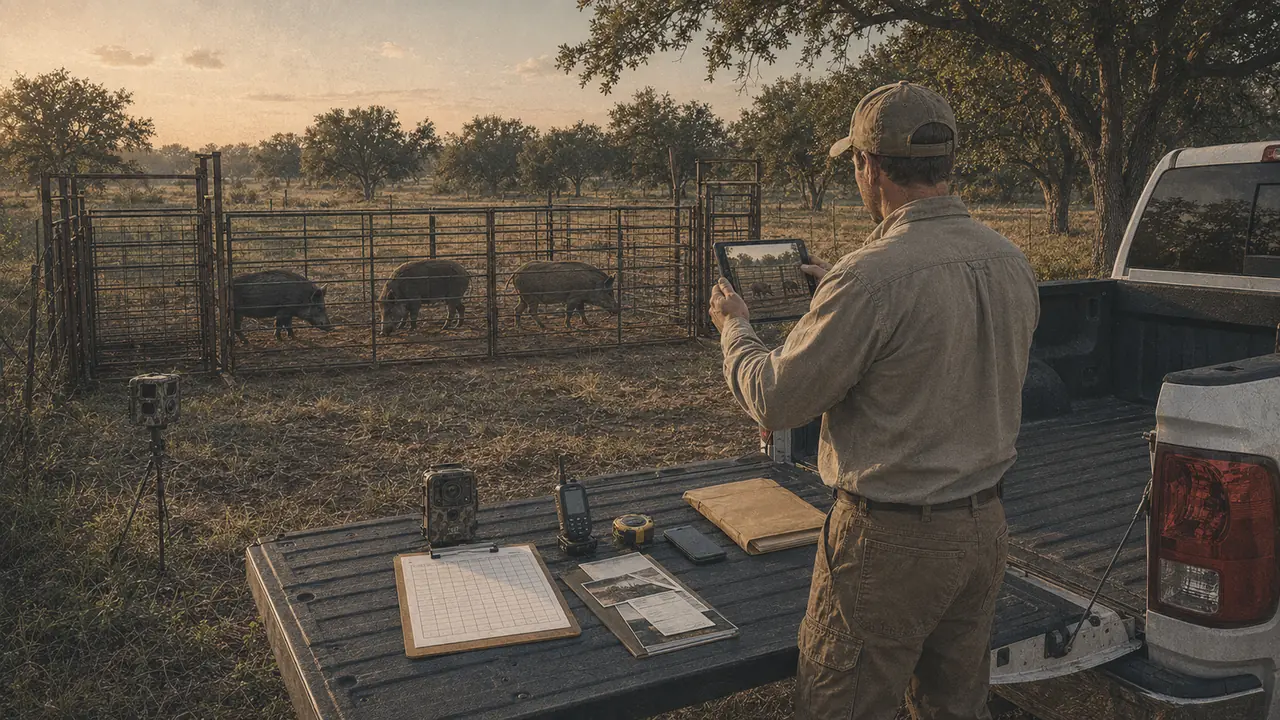
What outcome evaluation needs
Public program reporting frequently supplies the first item and rarely all of them:
- A count of removals, tails, or animals handled.
- A time period, so rates rather than totals can be compared.
- Area or site count, so a county and a single pasture are not compared as equals.
- Effort, such as equipment deployed, days active, or personnel time.
- Baseline damage measured before the work, using the same method afterward.
- Recurrence, complaints, or another program specific outcome measured after the work ended.
What the record shows
Two very different kinds of source point at the same gap.
Texas public programsActivity measures are published, consistency is not
Systematic review, 2024Most damage assessment has been qualitative
Why it matters
Activity numbers are the easiest thing to collect and the easiest thing to over read. They answer what was done. They do not answer whether the damage that prompted the work went down.
Notably, the Dallas solicitation asked for a plan with measurable damage reduction goals. That is a buyer asking for the harder measurement, which is exactly the gap the research literature describes.
This is not a claim that removal does not work
Nothing here says removal is ineffective, and nothing here says any specific Texas program failed. The point is narrower: activity and outcome are different questions, and most available reporting answers the first one. Where outcome measurement exists, it should be read on its own terms and with its own scope.
Limits and Scope of This Evidence
- Public program reports were designed for accountability and funding, not for cross program effectiveness comparison.
- The 2024 review describes the studies it included, not the performance of any program.
- Absence of quantified outcome data is a measurement gap, not evidence in either direction.
What This Page Does Not Claim
- That removal is ineffective, or that it is effective, at reducing damage.
- That any named program, agency, county, or operator failed or succeeded.
- That the 2024 review evaluated Texas programs.
- That TSSWCB, Texas A&M, TPWD, or any agency endorses this page.
Sources
Record reviewed . Documents linked below were public at that date. Contract requirements belong to the buying jurisdiction named, not to operators generally.
- Texas State Soil and Water Conservation Board, 2025 Annual Report (PDF)tsswcb.texas.gov/sites/default/files/files/docs/About/2025%20Annual%20Report%20for%20Web.pdf
- Systematic review of wild pig damage assessment (2024)doi.org/10.1007/s10530-024-03263-z
- City of Dallas RFCSP BTZ25-00028917 scope of workgovtribe.com/file/government-file/5-01-feral-hog-control-and-abatement-services-scope-of-work-dot-pdf
- City of Dallas RFCSP BTZ25-00028917 scope of work: Third-party mirror of the City of Dallas solicitation document, not a City-hosted copy.
Operator Perspective or Correction
If a document here is out of date, mischaracterized, or missing context, send the correction with its source to data@texashogdispatch.com. Field context from working operators is welcome. Nothing sent is published as an endorsement, and we do not publish proprietary methods, customer identities, property locations, or private price sheets.